Why This Guide Matters
Scars are one of the most common concerns I see at Hideaway Spa. Whether from acne, surgery, injury, or stretch marks, scarring affects how people feel about their skin and, often, themselves. The good news? Many scars respond extremely well to treatment. The challenge? Not every scar responds to the same approach, and aggressive isn't always better.
After 15+ years as a professional esthetician (including time in a dermatologist's office working with various scar treatment modalities), I've learned that understanding scar biology is just as important as understanding treatment techniques. This post breaks down:
- The four main types of scars and how to identify them
- Why scar maturity matters for treatment timing
- What the research actually says about different treatment depths
- When microchanneling is the right choice—and when thermolysis works better
- Why I default to conservative depths (0.25mm) and why that often produces better results than aggressive approaches
TL;DR: What You Need to Know
Short on time? Here's a condensed view before we dive into the science:
Scars form differently depending on injury type, skin tone, age, and genetics — and treatment should match the scar, not follow a one-size-fits-all protocol. Keloids require medical clearance before any collagen induction treatment. For most atrophic, hypertrophic, and surgical scars, precision microchanneling paired with growth factor serums delivers reliable improvement across all skin types — with less risk, less downtime, and better long-term outcomes than more aggressive approaches. Even with treatment, most scars cannot be fully restored but large improvements are often possible.
Keep reading for the detailed science behind each recommendation ↓
How Scars Form: The Biology Basics
Scars are an inevitable part of the body's repair process. When the dermis—the skin's deeper structural layer containing collagen, elastin, and blood vessels—sustains damage, the body mobilizes collagen to close the wound.1
However, this repair process doesn't perfectly recreate the original skin architecture. Instead of the basketweave pattern of collagen found in healthy skin, scar tissue forms in parallel bundles—structurally weaker and visually different from surrounding tissue.2
Factors That Influence Scar Formation
The final appearance of a scar is shaped by a complex interplay of variables:
- Depth and mechanism of injury: Deeper wounds, burns, or injuries involving significant tissue loss produce more substantial scarring
- Age: Younger skin produces more collagen but may overproduce (hypertrophic scars); older skin heals more slowly with less collagen (potentially atrophic)
- Genetics: Some people are genetically predisposed to keloid formation or poor healing
- Skin tone (Fitzpatrick type): Darker skin tones (IV-VI) have higher risk for keloids and post-inflammatory hyperpigmentation3
- Hormonal status: Pregnancy, puberty, and hormonal fluctuations affect healing
- Wound location: High-tension areas (chest, shoulders, joints) scar more prominently
- Initial wound care: Infection, poor closure technique, or excessive movement during healing worsens scarring
Understanding these variables matters because not every scar responds to the same treatment, and not every treatment approach is appropriate for every skin type. This is why consultation and proper assessment are so critical before beginning any scar revision protocol.
The Four Main Types of Scars
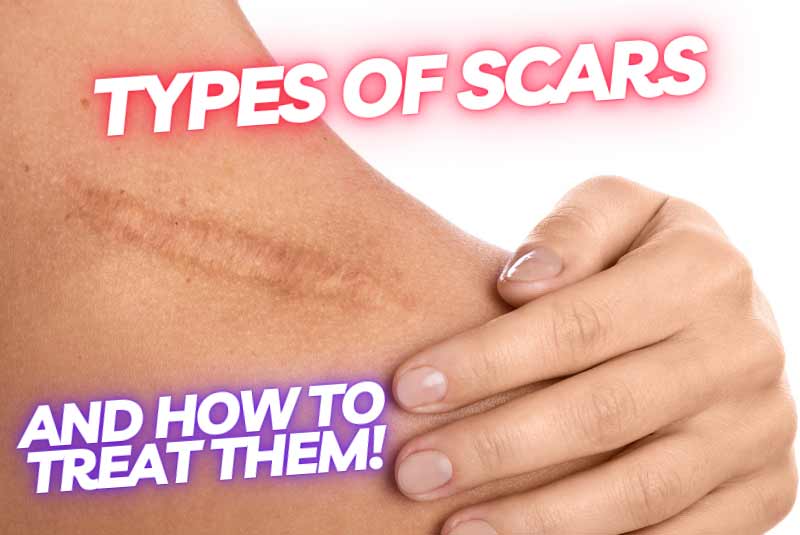
Scars are medically classified into four main categories based on their appearance, structure, and biological characteristics. Identifying which type you're dealing with determines the appropriate treatment approach.
1. Normotrophic Scars
Represent normal wound healing. Sit flush with surrounding skin, remain within the original injury boundary, and typically fade toward natural skin tone over time.
Common causes: Minor cuts, small surgical incisions, laparoscopic sites
2. Atrophic Scars
Form when healing produces insufficient collagen, leaving depressions below the skin surface. Most common from inflammatory acne and chickenpox.
Subtypes: Ice pick (deep, narrow), boxcar (flat-bottomed), rolling (wave-like)
3. Hypertrophic Scars
Result from excessive collagen production during healing. Appear raised, firm, often red/pink, and can cause itching. Stay within original wound boundary.
Common causes: Burns, high-tension surgical sites, areas with repeated movement
4. Keloid Scars
Dysregulated healing with dense fibrous tissue extending BEYOND original wound boundary. Do not regress on their own; can continue growing.
Risk factors: More common in Fitzpatrick IV-VI, genetic predisposition
The Critical Distinction: Hypertrophic vs. Keloid
This distinction is clinically essential and determines whether collagen induction therapy is appropriate:
- Hypertrophic scars stay within the boundary of the original wound. They may be raised and firm, but they don't "spread" beyond where the injury occurred.
- Keloid scars extend beyond the original wound boundary—visually appearing as if the scar has "blurred" or "melted" past the incision line. This outward spread is the definitive clinical sign.
⚠️ Keloids Are a Hard Contraindication
Keloids must NOT be treated with microchanneling or any collagen induction therapy. Introducing new collagen stimulus to tissue that's already producing collagen in a dysregulated, overabundant manner risks making the scar significantly worse.4
The appropriate pathway is dermatologist referral for corticosteroid injection to disrupt fibrous bonds and calm collagen overproduction, followed by medical clearance before any microneedling treatment is considered.
Stretch Marks: A Special Case of Atrophic Scarring
Stretch marks (striae distensae) are a subtype of atrophic scarring that form when rapid skin stretching—from pregnancy, rapid growth, significant weight change, or bodybuilding—disrupts the dermal collagen and elastin network.5
Running a finger across stretch marks typically reveals the characteristic divots of lost structural support. They respond well to microchanneling, though mature white stretch marks (striae albae) require realistic expectations about pigment restoration (more on this in the maturity section).
Acne Scar Subtypes: Why They Matter
Within atrophic scarring, acne scars are further classified into three subtypes, each with different treatment responsiveness:
- Ice pick scars: Deep, narrow channels tapering toward the base. These are structurally challenging—they respond poorly to microchanneling alone due to their depth and narrow width. Often require complementary approaches or thermolysis for individual deep scars.
- Boxcar scars: Wider, flat-bottomed depressions with sharply defined edges. Respond favorably to collagen induction—the broader base allows new collagen to fill effectively.6
- Rolling scars: Wave-like texture from fibrous tethering. Often respond best to microchanneling as the treatment can help release tethered tissue and stimulate new collagen formation.6
Immature vs. Mature Scars: Timing Matters
Beyond type classification, scars are also categorized by age—and this profoundly affects treatment timing and expectations.
Immature Scars (0-6 Months Post-Injury)
Characteristics:
- Red or pink coloration (increased vascularity)
- Some swelling or elevation
- Active remodeling—tissue is still changing
- May feel firm or tender
Immature scars are still in active remodeling phase. While some gentle interventions may be appropriate (silicone sheeting, gentle massage, proper sun protection), aggressive collagen induction should generally wait until the scar has matured—typically 3-6 months minimum, though I often recommend waiting closer to 6-12 months for surgical scars.
Why wait? The body is already actively remodeling. Adding mechanical trauma during this phase can disrupt the natural healing process and potentially worsen the final outcome.
Mature Scars (6+ Months Post-Injury)
Characteristics:
- Stable color—either normalized, hyperpigmented (darker), or hypopigmented (lighter)
- Swelling has resolved
- Texture is established and unlikely to change without intervention
- Remodeling has stabilized
Mature scars are ideal candidates for collagen induction therapy. The tissue has stabilized, and mechanical stimulation can now trigger renewed collagen production without interfering with natural healing processes.
The Pigmentation Question: Critical for Expectations
Hyperpigmented (darkened) mature scars can improve significantly with treatment. The controlled healing response helps melanocytes turn over, and the scar typically lightens over a series of treatments.7
Important note: The scar may appear temporarily darker before it lightens—this is a normal and expected part of the process as the treatment stimulates melanocyte activity before the turnover occurs.
Hypopigmented (lightened/white) mature scars present a critical limitation that must be discussed honestly with clients:
Once melanocytes in scar tissue are permanently lost, pigment cannot be restored through collagen induction or any topical treatment.8
What microchanneling CAN achieve with hypopigmented mature scars:
- Improved texture and surface smoothness
- Better visual integration with surrounding skin
- Reduced depth (for atrophic scars)
- Softer, less noticeable appearance
What it CANNOT achieve:
- Restoration of lost pigment in white stretch marks or hypopigmented scars
Clients must understand this limitation before treatment begins to prevent disappointment.
Treatment Options: What the Evidence Shows
Several established approaches exist for scar treatment, each with distinct mechanisms, risk profiles, and suitability ranges. Understanding these helps explain why I've chosen specific modalities at Hideaway Spa.
| Treatment | Best For | Fitzpatrick Safety | Downtime | Key Risks | Epidermal Preservation |
|---|---|---|---|---|---|
| Corticosteroid Injection | Keloids, hypertrophic scars | All types | Minimal | Skin atrophy with repeated use | N/A (injection) |
| Silicone Gel/Sheeting | Hypertrophic, post-surgical | All types | None | Skin irritation | Yes |
| Ablative Laser | Atrophic scars, texture | I-III primarily | 7-14+ days | Thermal injury, PIH, prolonged healing | No |
| Deep Chemical Peel | Atrophic, pigmentation | I-III primarily | Variable (7-14+ days) | Inflammation, PIH | No |
| Traditional Microneedling | Atrophic, hypertrophic | All types (with care) | 5-7 days | PIH in higher Fitzpatricks with dragging | Yes |
| Procell Microchanneling | Atrophic, hypertrophic, stretch marks, surgical | All Fitzpatrick types | ~90 minutes | Temporary darkening of hyperpigmented scars | Yes |
| Thermolysis (Electrodessication) | Individual deep ice pick scars, pitted cyst scars | All types | 3-7 days (per scar) | Temporary redness, minimal risk | Yes (surface only) |
Why I Focus on Microchanneling and Thermolysis
At Hideaway Spa, I've chosen to specialize in Procell microchanneling and thermolysis for scar treatment. Here's why:
1. Epidermal Preservation
Both techniques preserve the epidermis rather than ablating it. This is a meaningful clinical advantage, particularly for higher Fitzpatrick types where epidermal disruption carries elevated post-inflammatory hyperpigmentation (PIH) risk.9
2. Safety Profile
The risk-to-benefit ratio strongly favors these approaches. Ablative lasers and deep chemical peels can produce dramatic results but carry significant risks: thermal injury, prolonged healing (7-14+ days), excessive scarring, increased photosensitivity, and irregular pigmentation.10
3. Fitzpatrick Compatibility
Both microchanneling and thermolysis are safe for all skin tones. This isn't a marketing claim—it's a structural outcome of the techniques. Because we're not ablating tissue or creating thermal injury, we avoid the melanocyte disruption that drives PIH in darker skin tones.
4. Minimal Downtime
Microchanneling: approximately 90 minutes of redness (some clients less). Thermolysis: 3-7 days for individual treated scars. Compare this to 7-14+ days for ablative approaches.
5. Evidence Base
A systematic review evaluating 33 articles found that all showed improvement in acne scar appearance after microneedling treatment.6 A separate meta-analysis found that microneedling without radiofrequency achieved superior results compared to RF-assisted variants.11
On Depth: The Case for Starting Conservative
This is where my approach diverges from many practitioners, and it's worth explaining in detail because the assumption that "deeper is better" is widespread but not well-supported by evidence.
The Conventional Wisdom
Standard microneedling protocols for scar treatment typically recommend 1.5-2mm needle depths.12 The logic is intuitive: deeper injury reaches more of the dermis, theoretically triggering a more robust healing response.
Some studies do support deeper depths for specific applications. However, this guidance was developed in the context of conventional rolling microneedling, which operates on a different mechanical premise than precision microchanneling.
The Problem with "Deeper is Better"
The deeper the injury, the more significant the inflammatory response. And inflammation, when prolonged or excessive, is not a neutral event—it's actively counterproductive.
Research shows that injuring the deeper layers of skin entails:10
- Risk of prolonged healing times
- Fibrosis of the papillary dermis (abnormal scar tissue formation)
- Excessive scarring (iatrogenic scarring from the treatment itself)
- Increased photosensitivity
- Irregular pigmentation
More trauma does not reliably produce more organized collagen—it can produce the opposite. The final healed state of wounds that close via secondary intention is represented by scar tissue: cross-linked collagen that usually aligns in a single direction, disorganized relative to native skin architecture.2
Why 0.25mm Works: The Hideaway Spa Approach
At Hideaway Spa, my default starting depth for scar treatment is 0.25mm, and in the majority of cases, it remains sufficient throughout the entire treatment series. Here's the scientific rationale:
1. The Papillary Dermis Is the Target
At 0.25mm, we're working precisely at the papillary dermis—the zone where the wound-healing cascade initiates, growth factor signaling begins, and new collagen deposition is triggered.13
Research shows that even a depth of 0.2mm significantly increases how well serums and treatments penetrate the skin.14 You don't need to reach the deep dermis to trigger collagen production—you need to reach the right depth with the right biological signals.
2. Growth Factor Serum Amplification
When paired with medical-grade growth factor serum (Procell MD Serum with 2x concentration) applied directly into freshly created channels, the mechanical stimulus is amplified considerably by molecular cues.
You're not simply creating injury and waiting—you're delivering targeted biological signals (TGF-β3, bFGF, aFGF, peptides, DNA repair enzymes) at precisely the moment tissue is most receptive.15
3. Stamping vs. Dragging Mechanics
The Procell stamping technique creates uniform vertical channels. Unlike rolling or dragging devices that create angled channels and tear tissue laterally as the needle exits at a different angle from entry, stamping reduces lateral shear and limits collateral trauma to surrounding healthy tissue.16
That surrounding healthy tissue is precisely what you need to drive the healing response in adjacent channels—damaging it is counterproductive.
4. Multiple Sessions vs. Single Aggressive Treatment
A shallower, more precise injury paired with high-quality serum in multiple sessions (typically 3-6 treatments spaced 4-6 weeks apart) typically outperforms a single aggressive deep session—with less downtime, less risk, and far less inflammation to manage.
5. The Can't-Undo Problem
Depth can always be increased in subsequent sessions if the clinical picture warrants it. What cannot be undone is excessive inflammation, thermal damage, or iatrogenic scarring from an overly aggressive initial approach.
This conservative approach has produced excellent clinical outcomes in my practice with minimal complications—which is ultimately what matters for both safety and client satisfaction.
Procell Microchanneling for Scar Treatment
Procell microchanneling combines precision mechanical injury with a sophisticated serum platform specifically engineered for wound healing and scar remodeling.
The MD Serum Advantage
The Procell MD Serum contains twice the growth factor concentration of the standard Pro Serum and includes:
- TGF-β3 (Transforming Growth Factor Beta-3): Plays a specific role in guiding organized, non-fibrotic collagen deposition—essentially helping the body lay down "normal" collagen rather than scar tissue collagen17
- bFGF & aFGF (Fibroblast Growth Factors): Stimulate fibroblast activity and collagen synthesis
- DNA repair enzymes: Nobel Prize-recognized enzymes that enter the nucleus and repair damaged DNA directly18
- Multiple peptides and cytokines: Support cellular communication and healing cascade optimization
Fitzpatrick Safety
Procell microchanneling is safe for all skin types—Fitzpatrick I through VI. This isn't marketing language; it's a structural outcome of the technique.
Because the epidermis is preserved rather than ablated, the melanocyte disruption that drives post-inflammatory hyperpigmentation in ablative approaches (lasers, deep peels) is largely avoided.9 Properly conducted treatments will not result in hyperpigmentation, keloid formation, or lasting negative side effects.
Tip Selection Matters
For scar treatment, tip size is as important as depth:
- Precision tip (12 pins, ~diameter of a dime): For small surgical scars, individual hypertrophic scars, and targeted acne scarring where treating surrounding healthy skin is unnecessary and potentially counterproductive. That healthy tissue drives the healing response in adjacent channels.
- Face tip or body tip: For widespread acne scarring, stretch marks, or large surgical scars where broad coverage is needed and efficiency matters.
Expected Timeline
Scar treatment typically requires 3-6 sessions spaced 4-6 weeks apart. The number depends on:
- Scar age (older scars often need more sessions)
- Scar depth and severity
- Scar type (rolling and boxcar respond faster than ice pick)
- Individual healing capacity (declines with age as collagen production slows)
- Adherence to aftercare protocols
Improvement is progressive—you won't see dramatic change after one session. Collagen remodeling takes weeks to months to become visible.
Thermolysis for Deep Individual Scars
While microchanneling excels at treating widespread or shallow-to-moderate scarring, there's a specific scar type where a different approach produces better results: deep individual ice pick scars and pitted cyst scars.
When Microchanneling Isn't Enough
Ice pick scars—deep, narrow channels that taper toward the base—respond poorly to microchanneling alone. The structural challenge is that they're too deep and too narrow for the collagen stimulus to effectively fill from the bottom up.
Similarly, deep pitted scars from cystic acne create a focal depression that benefits from targeted intervention rather than broad-area treatment.
How Thermolysis Works for Scars
Thermolysis uses precise radiofrequency energy delivered through a fine probe to create controlled coagulation at the base of the scar. This triggers a wound-healing response specifically in that deep, narrow channel—stimulating collagen production from the bottom up to fill the depression.19
The mechanism is different from microchanneling:
- Microchanneling: Creates numerous shallow channels across a broad area to trigger diffuse collagen remodeling
- Thermolysis: Creates a single, precisely targeted thermal injury at the base of a deep scar to stimulate focused collagen production upward
The Treatment Process
For deep cyst scars or ice pick scars:
- The scar is assessed with a dermatoscope to determine depth and structure
- A fine thermolysis probe is inserted to the base of the scar depression
- Controlled radiofrequency energy coagulates tissue at the base (typically 5-20 seconds)
- The thermal injury triggers collagen production that fills upward over subsequent weeks
- Multiple treatments may be needed for very deep scars (typically 3-6 sessions)
Combining Approaches
For clients with both widespread acne scarring (rolling/boxcar) and individual deep ice pick scars, it's possible to combine approaches:
- Microchanneling for the broad areas of texture and shallow scarring
- Thermolysis for targeted treatment of individual deep scars
This combination addresses different scar structures with the most appropriate technique for each, producing better overall results than either approach alone.
Watch the Process: I've created video demonstrations of thermolysis treatment for pitted cyst scars on the thermolysis page. Seeing the actual procedure helps clients understand what to expect and why this approach works for scars that microchanneling can't adequately address.
Realistic Expectations: What Treatment Can and Cannot Do
Setting realistic expectations is perhaps the most important part of scar treatment consultation. The psychological burden of scarring is well-documented—acne alone is a highly prevalent condition leading to both psychological distress and physical scarring consequences.20
Clients seeking scar revision often come from a place of significant self-consciousness about how scars affect their appearance, clothing choices, and confidence. This deserves acknowledgment and honest conversation about what's achievable.
What Microchanneling Can Reliably Achieve
- Reduction in scar depth and surface texture irregularity
- Improvement in hyperpigmented scar color over a series of treatments
- Softening and relaxation of contracted or puckered scar tissue
- Better visual integration of the scar with surrounding skin
- Improved texture of mature stretch marks
What It Cannot Achieve
- Restoration of pigment in hypopigmented mature scars (white stretch marks, white scars)
- Resolution of active keloids without prior medical intervention
- Complete elimination of deep scars in a single session
- Results in scars less than 6 months old (wait for maturity)
- Instant results (collagen remodeling takes 4-6 weeks minimum per session)
The Goal Is Improvement, Not Perfection
The realistic goal of scar revision is significant improvement in appearance, not complete elimination. Scars represent fundamental changes in skin structure—we can improve how they look and feel, but we cannot turn scarred skin back into virgin, never-injured tissue.
What clients typically experience:
- 50-70% improvement in shallow-to-moderate acne scarring over a full treatment series6
- Noticeable softening and texture improvement in surgical scars
- Reduced visibility of stretch marks (especially recent pink/red ones)
- Greater confidence in their skin, even when the scar isn't completely gone
The Consultation: Where Treatment Really Begins
A thorough consultation is as important as any technical decision made during treatment. For scar revision at Hideaway Spa, consultation includes:
Clinical Assessment
- Scar type identification (normotrophic, atrophic, hypertrophic, or potential keloid)
- Scar maturity (age since injury)
- Dermatoscopic examination for depth and structure
- Fitzpatrick type assessment
- Identification of contraindications
History Intake
- Cause and timeline of scarring
- Previous treatment attempts and outcomes
- Current skincare products and medications (especially retinoids, which must be discontinued before treatment)
- Sun exposure habits and willingness to comply with strict photoprotection
- Healing history (keloid tendency, poor healing, PIH history)
Goal Discussion
- What does the client hope to achieve?
- What would constitute success for them?
- Honest conversation about realistic outcomes for their specific scar type
- Timeline and commitment discussion (scar treatment requires multiple sessions)
- Financial investment and whether it aligns with realistic expectations
This conversation-based approach ensures we're aligned on goals, timeline, and expectations before beginning treatment—which significantly improves satisfaction and compliance.
Final Thoughts: Conservative, Precise, Evidence-Based
Scar treatment doesn't require aggressive depths, thermal injury, or prolonged downtime to be effective. What it requires is:
- Accurate scar type identification to select appropriate treatment
- Respect for skin biology and the healing process
- Precision technique that maximizes stimulus while minimizing collateral damage
- Quality biological signals (growth factor serums) paired with mechanical injury
- Multiple sessions allowing progressive collagen remodeling
- Realistic expectations and honest conversations about achievable outcomes
At Hideaway Spa, the combination of conservative-depth Procell microchanneling for broad scarring and targeted thermolysis for deep individual scars produces excellent results with minimal risk across all skin types.
The research supports this approach. My 15+ years of clinical experience supports it. And most importantly, client outcomes support it.
If you're considering scar treatment and want an evidence-based, conservative-first approach that respects your skin's biology in the Windsor-Essex region, I'm here to help.
References & Scientific Literature
- Gurtner GC, Werner S, Barrandon Y, Longaker MT. Wound repair and regeneration. Nature. 2008;453(7193):314-321.
- Ud-Din S, Bayat A. Non-animal models of wound healing in cutaneous repair: in silico, in vitro, ex vivo, and in vivo models of wounds and scars in human skin. Wound Repair Regen. 2017;25(4):164-176.
- Davis EC, Callender VD. Postinflammatory hyperpigmentation: a review of the epidemiology, clinical features, and treatment options in skin of color. J Clin Aesthet Dermatol. 2010;3(7):20-31.
- Berman B, Maderal A, Raphael B. Keloids and Hypertrophic Scars: Pathophysiology, Classification, and Treatment. Dermatol Surg. 2017;43 Suppl 1:S3-S18.
- Ud-Din S, McGeorge D, Bayat A. Topical management of striae distensae (stretch marks): prevention and therapy of striae rubrae and albae. J Eur Acad Dermatol Venereol. 2016;30(2):211-222.
- Jaiswal S. Microneedling in Dermatology: A Comprehensive Review. Cureus. 2024;16(10):e71479. PMC11499218. Systematic review of 33 articles showing improvement in acne scar appearance.
- Aust MC, Fernandes D, Kolokythas P, Kaplan HM, Vogt PM. Percutaneous collagen induction therapy: an alternative treatment for scars, wrinkles, and skin laxity. Plast Reconstr Surg. 2008;121(4):1421-1429.
- Lim HW, Grimes PE, Agbai O, et al. Afamelanotide and narrowband UV-B phototherapy for the treatment of vitiligo: a randomized multicenter trial. JAMA Dermatol. 2015;151(1):42-50. Discussion of permanent melanocyte loss.
- Ramaut L, Hoeksema H, Pirayesh A, Stillaert F, Monstrey S. Microneedling: Where do we stand now? A systematic review of the literature. J Plast Reconstr Aesthet Surg. 2018;71(1):1-14.
- Hantash BM, Bedi VP, Kapadia B, et al. In vivo histological evaluation of a novel ablative fractional resurfacing device. Lasers Surg Med. 2007;39(2):96-107. Discussion of risks from deeper ablative approaches.
- Mujahid N, Shareef F, Maymone MBC, Vashi NA. Microneedling as a Treatment for Acne Scarring: A Systematic Review. Dermatol Surg. 2020;46(1):86-92. Meta-analysis finding superior results without RF.
- Doddaballapur S. Microneedling with dermaroller. J Cutan Aesthet Surg. 2009;2(2):110-111.
- Singh A, Yadav S. Microneedling: Advances and widening horizons. Indian Dermatol Online J. 2016;7(4):244-254. PMC4976400.
- Henry S, McAllister DV, Allen MG, Prausnitz MR. Microfabricated microneedles: a novel approach to transdermal drug delivery. J Pharm Sci. 1998;87(8):922-925. PMC3921236.
- Procell Therapies. Procell MD Serum formulation and growth factor concentration data. Available at: procelltherapies.com/faq. Accessed January 2026.
- Shen YC, Zhu BH, Tsai TY, et al. Efficacy and Safety of Microneedling for Treating Scars: A Systematic Review and Meta-analysis. Aesthetic Plast Surg. 2022;46(3):1105-1119.
- Shah M, Foreman DM, Ferguson MW. Control of scarring in adult wounds by neutralising antibody to transforming growth factor beta. Lancet. 1992;339(8787):213-214. TGF-β3 role in organized collagen deposition.
- Lindahl T. Instability and decay of the primary structure of DNA. Nature. 1993;362(6422):709-715. Nobel Prize research on DNA repair mechanisms.
- Kim DH, Hyun DJ, Piquette R, et al. 27.12 MHz Radiofrequency Ablation for Benign Cutaneous Lesions. Biomed Res Int. 2016;2016:6016943. PMC4835659.
- Sitohang IBS, Badaruddin MR, Jusuf NK. Psychological impacts of acne vulgaris and the effects of its treatments: A narrative review. Int Wound J. 2021;18(5):577-585.
Disclaimer: This article provides evidence-based information for educational purposes and should not replace professional medical advice. Scar treatment requires individual assessment to determine appropriate approaches. Keloids must be evaluated by a dermatologist before any collagen induction therapy. Always consult with a qualified esthetician or dermatologist about appropriate treatments for your specific scar type and skin concerns.
Republishing Policy: You are welcome to quote or repost excerpts from this article with proper credit and a direct link back to the original at https://windsorskinwitch.ca/blog/scar-treatment-guide
Please do not republish the entire article without linking back to the source.
Related Reading
- Microneedling Serums Compared: Growth Factors, PRP, PDRN & Exosomes
- Skin Rejuvenation Treatments Guide: Peels, Needling & More →
- Ultherapy vs Microchanneling: What the Science Actually Says →
- Fall Skin Repair: Why Timing Matters →
- Thermolysis & Blemish Correction at Hideaway Spa →
- Procell Microchanneling at Hideaway Spa →
- The Hidden Dangers of RF Microneedling →