Why This Guide Exists
After 15+ years as a professional esthetician — including time working in a dermatologist's office — and performing thousands of waxing services at Hideaway Spa in Windsor, I get the same questions every single week: "What's better — laser, waxing, or electrolysis?" "Does shaving really make hair grow back thicker?" "Are depilatory creams safe?"
Most online advice is marketing fluff, exaggerated claims, or outdated myths. This guide cuts through it with peer-reviewed studies, clinical data, and official Health Canada and FDA statements. We'll cover all the major methods — shaving, depilatory creams, waxing, sugaring, threading, epilators, laser (all major types), and electrolysis/thermolysis — without discrediting any of them. Every method has its place.
TL;DR: Quick Summary
Hair Growth Cycles 101 — Why This Matters for Every Method
Hair growth isn't continuous — follicles cycle through three distinct phases, and understanding them explains why no single treatment session eliminates hair permanently and why consistent scheduling matters.
- Anagen (active growth): The follicle is actively producing hair and is at its deepest. This is the phase where the follicle is most vulnerable to targeted damage from laser, electrolysis, or waxing from the root. Duration varies dramatically by body site — scalp hair stays in anagen for 2–6 years; eyebrows for only 4–7 months; leg hair for roughly 19–26 weeks.1
- Catagen (transition): A brief 2–3 week shutdown phase where the follicle detaches from its blood supply and the hair shaft moves upward.
- Telogen (resting/shedding): The hair rests for 3+ months before naturally shedding and being replaced by a new anagen hair.
For most body sites, only a fraction of follicles are in anagen at any given moment — estimates for body hair generally range from roughly 20–30%.1 This is why laser and electrolysis require multiple sessions spaced weeks apart (to catch follicles as they enter anagen), and why consistent waxing every 4–6 weeks continues to catch new growth in waves. It's also part of why facial and hormonal-area hair is notoriously harder to treat permanently — the cycles are shorter and more hormonally driven.
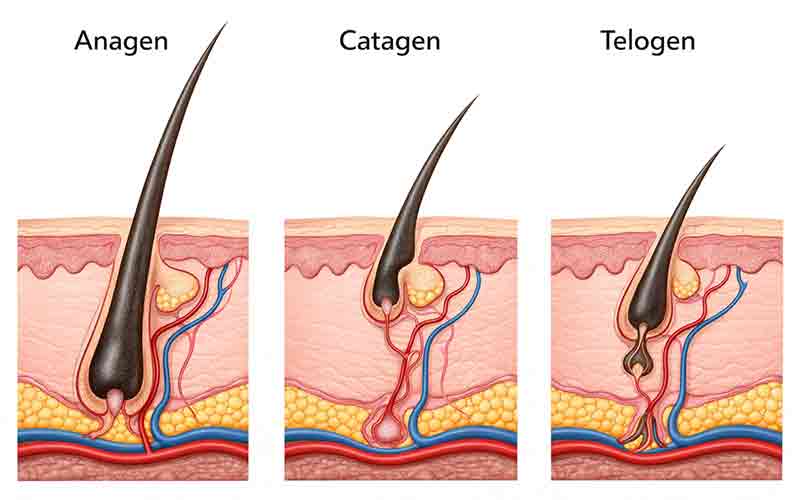
Diagram of the hair growth phases
Shaving — Quick and Cheap
How it works
A blade cuts the hair shaft flush with (or just below) the skin surface. No root removal, no follicle disruption.
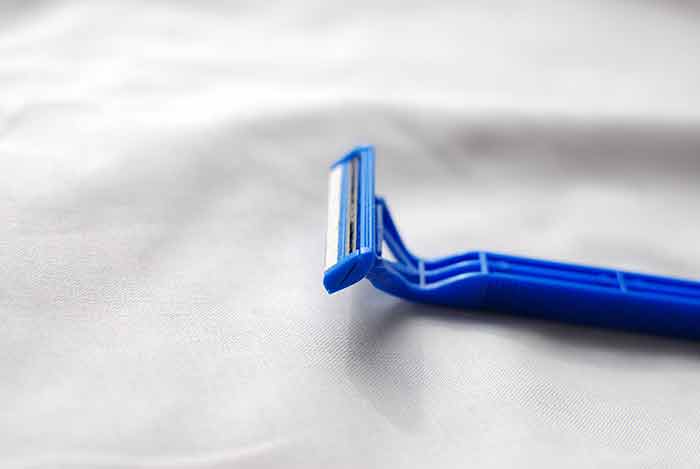
A standard disposable razor used for shaving
Pros
- Inexpensive and requires no appointment
- Immediate results anywhere, any time
- Relatively low pain when done carefully
Cons — backed by science
- Shortest results: Hair returns visibly within 1–3 days because only the surface is removed.
- Skin dryness: A 2020 study in the International Journal of Cosmetic Science (Evans et al.) compared shaving, plucking, and waxing in the axilla. It found shaving caused significantly greater skin dryness than waxing or plucking — attributed to the physical disruption of the stratum corneum with each pass of the blade.2
- Inflammatory response: The same study found that all three methods — including waxing — raised inflammatory markers (IL-1α and IL-1RA) in the skin. Shaving did cause less visible erythema than waxing immediately post-removal, but the greater dryness indicates compromised barrier function over repeated use.2
- Ingrown hairs and folliculitis: Blunt-cut hair tips, combined with clogged follicles, increase the likelihood of hairs curling back into the skin — particularly in coarse, curly hair.
- Micro-cuts: Regular shaving creates micro-abrasions that can impair the skin barrier, introduce bacteria, and worsen irritation over time.
Best for: Quick touch-ups between waxing appointments. We generally don't recommend shaving between wax sessions, as it can reset your hair growth cycles and affect the quality of your next wax. See our Waxing Aftercare Guide for details on why.
Shaving is quick, easy, and affordable. No one can deny it's the most accessible for everyone. That said, it also unfortunately has the shortest lasting result and isn't necessarily the best for your skin.
Depilatory Creams — Hair Removal by Chemical Breakdown
How they work
Depilatory creams use alkaline thioglycolate compounds (typically calcium thioglycolate or potassium thioglycolate) to break the disulfide bonds in the keratin protein that makes up the hair shaft. The hair dissolves above or at the skin surface and wipes away. No root removal occurs.
Pros
- Painless application — no pulling or heat
- At-home convenience, no appointment needed
- Results slightly longer than shaving — typically a few days to about 2 weeks, as the hair tapers more gradually than a blunt shave cut
Cons — backed by science
- High irritation potential: The same alkaline chemistry that dissolves hair can damage skin. Studies consistently document significant rates of contact dermatitis, erythema, and chemical burns — particularly with prolonged application or use on sensitive skin.4 Even products marketed for "sensitive areas" carry meaningful risk.
- Not suitable for repeated use on large areas: Cumulative chemical exposure can compromise the skin barrier over time.
- No long-term benefit: Because only the shaft is removed (not the root), there is no progressive follicle weakening, no finer regrowth over time — just repeat chemical exposure.
- Odour and mess: The sulfur chemistry in most formulas produces a distinctive unpleasant smell.
Best for: Occasional use on areas where shaving is awkward (e.g., the back of legs) for users without skin sensitivity. Not recommended for intimate areas, faces with sensitive skin, or anyone prone to contact dermatitis.
I am not personally a fan of depilatory creams due to their high allergen risk as well as the nature of how they work. Given they're designed to chemically penetrate and break down the hair shaft from within, it's difficult to imagine the surrounding skin escaping some degree of collateral chemical exposure in the process.
Waxing — A Practical Root-Removal Option
How it works
Wax is applied to the skin, adheres to the hair shaft, and is removed quickly — pulling hair out from the follicle root. When hair is removed in anagen (active growth phase), the follicle must rebuild from the base, which is why results last 3–6 weeks rather than the 1–3 days you get from surface cutting.
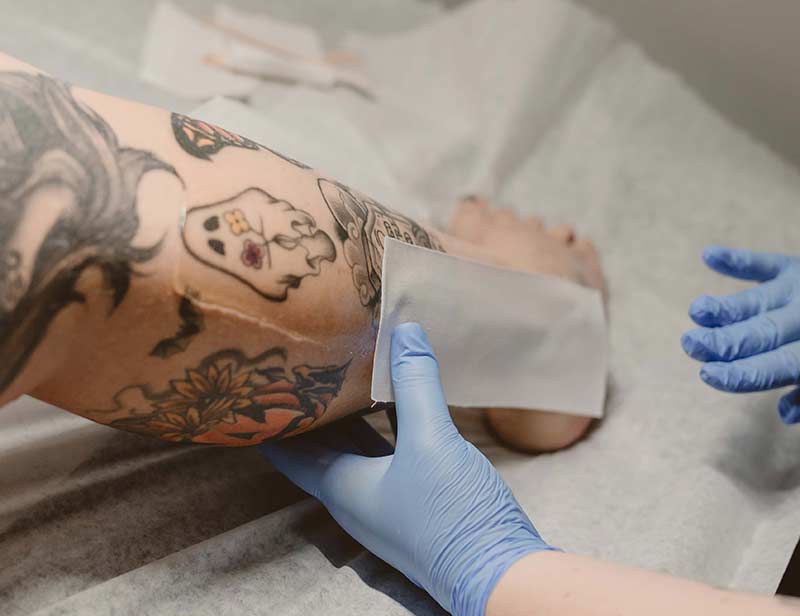
Leg being waxed with soft wax at Hideaway Spa in Windsor, ON
Why the science supports it
- Longer smoothness: Hair removed from the root must regrow from scratch — typically 3–6 weeks before it becomes visible again, versus 1–3 days with shaving.5
- Progressive follicle weakening: Biophysical research shows that repeated waxing can gradually reduce hair density and lead to finer, softer regrowth over time as the follicle is repeatedly disrupted.6 This benefit builds session over session — a major advantage over methods that only remove the surface hair.
- Built-in exfoliation: Wax removes dead skin cells along with hair, leaving a mild exfoliation effect that improves skin texture. This is something laser and electrolysis don't provide.
- Reduced chronic skin damage vs. shaving: The Evans et al. (2020) study found that while waxing does cause more immediate visible redness than shaving (expected from root removal), shaving caused significantly greater ongoing skin dryness — a marker of compromised barrier function — than waxing did in the same study.2
- Works for all skin tones and most body areas: Unlike laser, waxing efficacy is not dependent on the contrast between hair colour and skin tone. It works on blonde, red, grey, and white hair — and on all Fitzpatrick skin types.
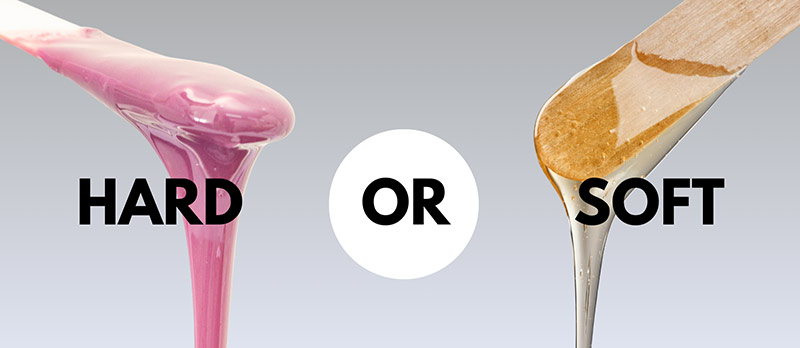
Hard or soft, what's the difference?
Hard wax vs. soft wax — what we use and why
- Hard wax shrinks around the hair as it cools, gripping the shaft without adhering strongly to skin. It's often gentler on sensitive skin given it primarily bonds to the hair rather than skin.
- Soft wax is applied in a thin layer and removed with a muslin strip. It's better for fine hair and provides maximum exfoliation. It's typically faster given it adheres to everything.
At Hideaway Spa, we use both — choosing based on the area being treated and your individual skin and hair type.
Brazilian & men's waxing
Full Brazilian waxing — and male Brazilian waxing in particular — requires specialized technique and training. Male anatomy presents unique considerations for positioning, skin tension, and tissue sensitivity. My recommendation for men is to ensure their practitioner has been trained on male anatomy; there is a difference and you'll be far more comfortable. I've been trained in male-specific waxing techniques and hope more estheticians also do so in the future given male Brazilians are becoming increasingly popular. I've personally seen a large influx of male clients in Windsor year over year.
The ingrown hair question
The single most common waxing concern — and one that's almost entirely preventable with proper aftercare. Ingrowns happen when the hair curls back into the follicle instead of emerging through the skin surface. The solution is exfoliation — but not immediately, and not just aggressive scrubbing, which can worsen inflammation. Full protocol in our evidence-based Waxing Aftercare Guide →
Yes, the first few waxing sessions can feel more intense than expected — especially for Brazilians. That's completely normal. Most clients find it significantly less uncomfortable after the first 2–3 sessions as the follicle weakens and hair becomes finer. The post-wax smoothness and the fact that you're not shaving every day tends to win people over pretty quickly. The key is consistency — and proper aftercare.
Sugaring — Waxing's Ancient Cousin
How it works
Sugaring uses a thick paste made from just three ingredients — sugar, lemon juice, and water — heated to a pliable consistency and applied directly with the hands (no strips needed in traditional technique). Crucially, it's applied against the direction of hair growth and removed with the direction of growth. This is the opposite of most soft waxing technique, and proponents argue it's a meaningful distinction: removing in the direction of growth means the hair is extracted following its natural angle rather than against it, theoretically reducing the rate of mid-shaft breakage and breakage-related ingrowns. Sugaring has roots in ancient Middle Eastern and Persian practices, where a similar sugar-lemon paste was traditionally used for smooth skin.
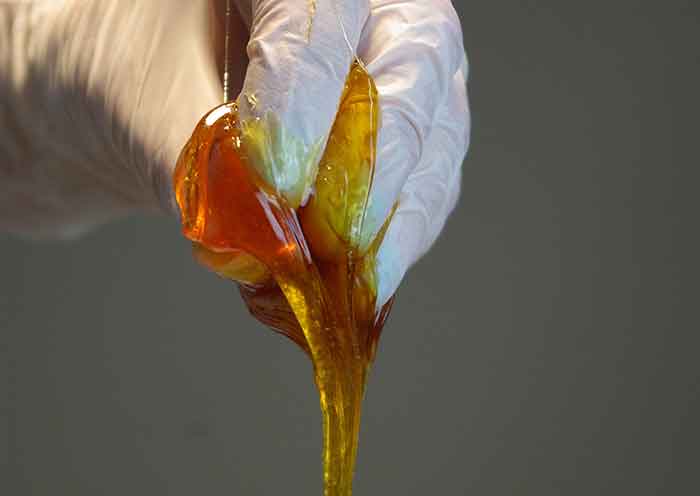
Sugaring paste being held
How it compares to waxing
- Results are comparable: Expect 3–5 weeks of smoothness with root removal. Hair must be a similar length to waxing — roughly 6–10mm — for the paste to grip properly.
- Gentler on sensitive skin: The paste is water-soluble, residue rinses away easily with warm water, and the formula contains no resins or synthetic adhesives. This makes it a strong option for clients who find wax causes persistent redness or irritation.
- The ingrown argument: The directional-removal difference is real in theory, but direct clinical evidence comparing ingrown rates between sugaring and waxing is limited. What's clear is that the paste is less likely to break hair than a worn epilator.
- Same hair-cycle logic applies: Consistent sessions every 4–6 weeks will progressively weaken follicles and produce finer regrowth over time — identical mechanism to waxing.
- Technique-dependent: Skilled sugaring practitioners are less common than waxing professionals. Poorly executed sugaring — wrong consistency, wrong temperature, wrong angle — loses most of its claimed advantages over waxing quickly.
Like any root-removal method, sugaring is not risk-free. Temporary redness, minor bruising, or folliculitis can occur, especially if the paste is too warm, left on too long, or technique is inconsistent. A small comparative study found higher rates of ingrown hairs and inflammation with sugar wax compared to hard wax in Brazilian treatments, highlighting the importance of proper technique and aftercare.14 Ingrown hairs remain possible with both sugaring and waxing, though many clients report they are less frequent when aftercare is followed. In Windsor’s humid summers, the water-soluble paste can feel stickier if not rinsed thoroughly, and sessions may take slightly longer than strip waxing for larger areas.
Best for: Clients with reactive or sensitive skin who still want root removal and a few weeks of smoothness. Also a reasonable alternative for anyone who prefers a fully natural-ingredient formulation.
In my years working with Windsor clients, I've found sugaring appeals most to those with very sensitive skin who want a natural, chemical-free option. I see it as an ancient cultural method with roots in the Middle East and Persia — a close cousin to waxing, but with its own distinct technique. Results still vary with hair texture.
Threading — Precision Facial Hair Removal
How it works
Threading is one of the oldest hair removal methods still in widespread use, originating in South Asia and the Middle East. A single length of cotton thread is twisted and rolled across the skin surface in a specific rolling motion — the twisted section catches individual hairs and pulls them from the follicle root in a clean, rapid extraction. No heat, no chemicals, no adhesives of any kind.
Where it excels
Threading's defining advantage is precision. An experienced threading practitioner can shape eyebrows, clean up a hairline, or remove upper lip hair with an accuracy that's very difficult to match with wax — individual hairs or precise rows can be targeted without disturbing adjacent ones. For this reason it remains the preferred method for eyebrow shaping for many clients, especially those wanting very defined, architectural brow lines.
Limitations
- Entirely technique-dependent: Threading is a manual skill with no device standardising the outcome. The quality of result varies significantly between practitioners — finding a skilled threader makes all the difference.
- Much slower than waxing or sugaring: A full eyebrow or upper-lip session can take significantly longer, making it impractical for anything beyond small facial zones.
- Can cause irritation: The rolling thread can produce redness, stinging, or minor skin trauma, especially on thin or sensitive facial skin. In rare cases with poor hygiene, folliculitis or transmission of viral skin issues (such as molluscum contagiosum or verrucae plana) has been reported.15
- Ingrown potential: Generally low for fine facial hair, but still possible.
Best for: Eyebrow shaping and precise facial hair removal. Not a replacement for waxing or any other method for body hair.
In my experience, threading shines when precision is needed, particularly for eyebrow shaping or fine facial hair. A truly talented threader can deliver clean, defined results that many clients love. That said, a skilled practitioner is absolutely essential — technique makes or breaks the experience.
Epilators — Convenient, But With a Design Problem Worth Knowing About
How they work
An epilator is an electric handheld device fitted with a rotating head of multiple small tweezers (or discs, or springs depending on the model). As it moves across the skin, these tweezers rapidly grasp and pull hairs. The intention is root removal — similar to waxing — giving a few weeks of smoothness before regrowth. In theory it sounds like DIY waxing on demand. In practice, there's an important mechanical distinction that changes the experience significantly.
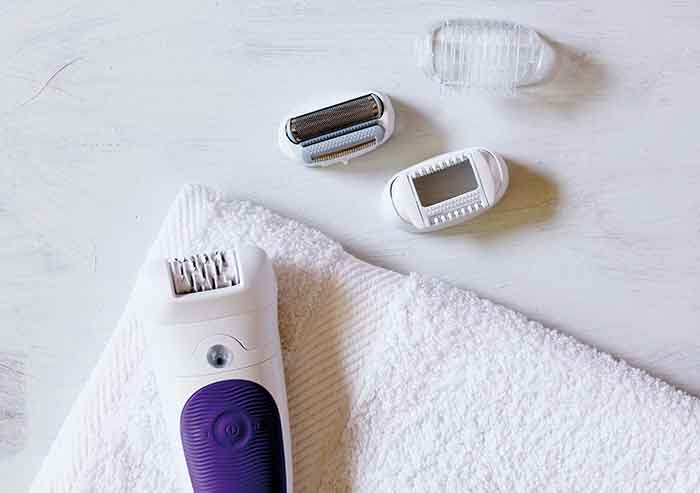
Epilator device for hair removal
Pros
- At-home convenience — no appointment, no hot wax, usable any time
- Lower ongoing cost than professional waxing once the device is purchased
- Results last 2–4 weeks (longer than shaving, shorter than professional waxing on average)
- Hair does become finer over time with repeated use, for the same reason as waxing — repeated follicle disruption
The core design problem — and why ingrowns are a bigger issue than with waxing
This is the part most epilator marketing glosses over. With professional waxing, the wax bonds along the full length of the hair shaft and removal is done in a single controlled pull — ideally a clean root extraction. An epilator works differently: dozens of tiny rotating tweezers grab individual hairs rapidly in sequence, at varying angles, with varying grip quality depending on hair length, skin tension, and device condition.
The result is that epilators frequently break hair below the skin surface rather than pulling it cleanly from the root — particularly when the hair is too short or too long for optimal grip, when the device is worn, or when the skin isn't held taut. A hair snapped just beneath the skin surface behaves exactly like a shaved hair with one important difference: it's now pointing at an angle, often sideways, and has to fight its way back through the dermis. That's an ingrown hair in the making.
The two primary mechanisms are well documented in hair removal literature: hair breakage below the skin surface, and follicle blockage from dead skin cells accumulating without the exfoliation effect that waxing provides.13
My concern with epilators goes a step further than just "they cause ingrowns sometimes." Because they pull from the follicle repeatedly in a less than uniform manner, there's a real risk over time of the follicle becoming distorted — essentially trained to grow the hair in the wrong direction. When that happens, you're not just dealing with a temporary ingrown that resolves with exfoliation. You can end up with a hair that persistently grows sideways within the dermis, chronic inflammation around that follicle, and a bump that doesn't go away easily.
This isn't guaranteed, and it's more common in people with naturally curly or coarse hair, but it's a meaningful risk that I don't think gets communicated enough. I've seen clients come in dealing with exactly this situation, and it's much harder to resolve than a standard post-wax ingrown. It's one reason I'm cautious about recommending epilators as a routine long-term method — especially for sensitive or coarse-hair areas like the bikini line. I personally view it as an old, outdated method with significant risk.
Other drawbacks
- Pain: Epilating is generally considered more uncomfortable than waxing, because hairs are removed one at a time in rapid succession over a prolonged period rather than in quick strips. Most users report it improves as hair becomes finer with repeated use, but initial sessions are notoriously painful.
- No exfoliation benefit: Unlike waxing, the epilator head doesn't contact the skin surface the way wax does, so there's no dead-cell removal. Regular separate exfoliation is essential to reduce follicle blockage.
- Device wear increases breakage: As the tweezers wear down, grip precision decreases and the rate of mid-shaft breakage increases. Most epilators need head replacement or full device replacement every 1–2 years.
- Not suitable for all areas: Coarser hair areas — bikini line, underarms — see the highest ingrown rates due to naturally curved hair shafts that are more prone to growing back inward after breakage.
If you do use one — how to reduce risk
- Exfoliate with a chemical exfoliant (AHA or BHA) 24–48 hours before epilating to clear follicle openings
- Use on dry skin with the skin held taut; move slowly and against the direction of hair growth
- Hair length matters: around 3–5mm is generally optimal — too short and the tweezers can't grip cleanly; too long and mid-shaft breakage increases
- Continue chemical exfoliation 2–3 times per week after epilating as hair regrows
- Replace device heads regularly — a worn epilator causes significantly more breakage
- Avoid on coarse, curly hair in sensitive areas if you're already prone to ingrowns
Bottom line: Epilators occupy an awkward middle ground — more convenient than professional waxing, but less effective at clean root removal and with a higher ingrown hair risk built into their design. For occasional use on fine hair with a consistent exfoliation routine, they're a reasonable option. As a long-term primary method for sensitive or coarse-hair areas, the chronic ingrown risk is real and worth taking seriously.
Laser Hair Removal — Types, Realistic Results & the Fine Print
How it works
Laser hair removal uses the principle of selective photothermolysis: a specific wavelength of light is absorbed preferentially by melanin (the pigment in hair follicles), generating heat that damages the follicle's growth cells while minimizing injury to surrounding skin. Because the mechanism depends on melanin contrast, it works most effectively on dark hair against lighter skin — and is less effective on light, grey, red, or white hair, which has little to no melanin to absorb the laser energy.
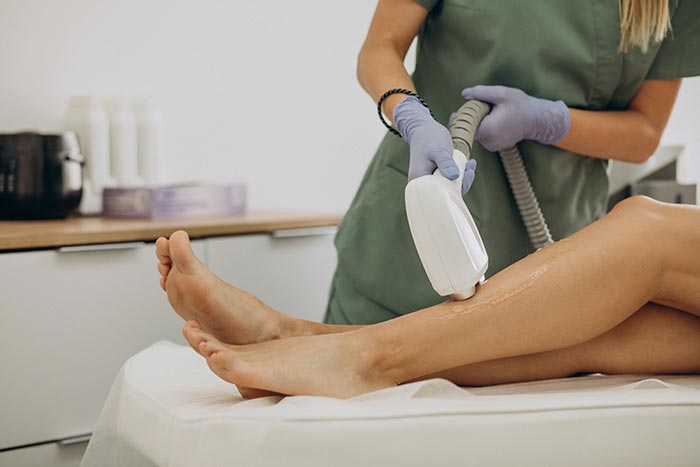
Laser hair removal treatment
The four main laser types
Alexandrite (755 nm)
Fastest and most effective for Fitzpatrick skin types I–III (fair to medium skin) with dark hair. Not suitable for tanned or darker skin.
Diode (800–810 nm)
Versatile middle-ground — effective for types I–IV. Good combination of efficacy and safety for a range of skin tones.
Nd:YAG (1064 nm)
The safest option for darker skin tones (Fitzpatrick IV–VI) and tanned skin. Penetrates deeper but slightly less efficient per session than Alexandrite or Diode.
IPL (not a true laser)
Intense pulsed light uses a broad spectrum rather than a single wavelength. Cheaper per session but less precise. Multiple systematic reviews show true lasers outperform IPL for long-term hair reduction.7
It should be noted some machines exist which have both Alexandrite and Nd:YAG settings.
What the evidence actually shows
This is where I want to be very clear, because the gap between clinic marketing and peer-reviewed evidence is significant.
 Health Canada's official consumer advisory states: "Depending on the operator and the laser system used, there may be some permanent hair reduction (about 30%), but there are no guarantees that the procedure will work for every person or on every part of a person's body."8 The FDA likewise clears laser devices only for "permanent hair reduction" — not permanent hair removal.
Clinical RCTs paint a somewhat more optimistic — but still variable — picture. A 2022 systematic review by Krasniqi et al. in the Journal of Cosmetic and Laser Therapy (the only review limited to trials with follow-up covering a full hair growth cycle) found the following long-term reduction ranges:9
- Nd:YAG laser: 30–73.6% reduction
- Alexandrite laser: 35–84.3% reduction
- Diode laser: 32.5–69.2% reduction
- IPL: 27–52.7% reduction
Critically, the review noted that the highest reductions were consistently observed when treating leg hair (which has a roughly one-year growth cycle), and the lowest reductions from facial hair — reflecting the importance of body site and hair cycle length. The reviewers also cautioned that only five eligible RCTs met their inclusion criteria, underscoring that long-term evidence in this field is still limited.
The wide ranges above are real — a good candidate (dark coarse hair, lighter skin, legs or body) treated with an Alexandrite laser by an experienced operator might see 70–84% long-term reduction. Someone treating fine facial hair, or hormonal-area hair that keeps cycling back, might see 30–40%. Results are genuinely variable.
What "reduction" means in practice
Even after a full treatment course, most people retain some hair — often finer and lighter than before, but present. Over years, especially in hormonally active areas (chin, upper lip, bikini line), gradual regrowth is common. Many clients find they need one or two maintenance sessions per year to sustain their results. Laser is not a "do it once, done forever" solution for most people — but it can be a genuinely life-changing reduction, and even a partial course of sessions can significantly lower hair density, making future waxing or electrolysis sessions faster and more comfortable.
Full disclosure: I'm a textbook ideal laser candidate — light skin, dark hair — and I've had laser sessions on multiple areas throughout my career. I've also personally operated several different laser systems professionally, so I've seen these devices from both sides of the handpiece.
The most honest result I can share: my underarms are a genuine laser success story. After completing my treatment course, I simply don't need to deal with that hair anymore. That's a real outcome, and I won't pretend otherwise — for the right area and the right candidate profile, laser absolutely can deliver that kind of result.
Other areas were more modest. Hair came back finer and slower, but it didn't disappear — and I still wax those spots for the smooth feel I want. That's the honest range of what laser looks like in practice: remarkable for some areas, meaningful reduction for others, and the difference often comes down to body site, hair cycle length, and how consistently you complete your sessions.
I've also used thermolysis on a few stray facial hairs with great results for true permanence on those specific spots. Bottom line: if your skin/hair profile and target area line up well, laser genuinely is the best long-term investment you can make — and even a partial course to knock down density can be worthwhile before maintaining with waxing.
Risks to know about
- Burns and pigmentation changes: Risk is elevated when the wrong device is used for a client's skin tone, when the operator is undertrained, or when the client has recently tanned. Darker skin tones are more susceptible to post-inflammatory hyperpigmentation with Alexandrite lasers — Nd:YAG is safer for those skin types.7
- Paradoxical hypertrichosis: A relatively rare but documented side effect where laser stimulates rather than damages follicles in certain areas — more common with low-fluence treatments on fine facial hair.
A 2021 systematic review and meta-analysis of over 9,700 patients found the overall rate to be approximately 3%. The risk is significantly higher on the face and neck, while being very low (around 0.08%) on other body areas.16Higher risk factors include:
- Treating the face, chin, upper lip, jawline, or neck
- Fine or vellus (peach fuzz) hairs — common in maintenance phases
- Hormonal conditions such as PCOS or irregular menstrual cycles
- Fitzpatrick skin types III–IV
- Not effective on light/grey/red/white hair: These hair types lack sufficient melanin for selective photothermolysis to work reliably. Electrolysis is the recommended alternative for these hair colours.
- Operator training matters — a lot: In Ontario, there are no provincial licensing requirements to operate a laser hair removal device — anyone can legally run one. Having personally operated multiple laser systems throughout my career, I can tell you that device settings, fluence selection, and skin assessment vary enormously between operators, and getting them wrong is how burns and pigmentation damage happen. Always ask about their hands-on training, experience with your specific skin tone, which device they use, and whether they perform a patch test. This is not a small detail.10
A note on IPL specifically: I do not personally recommend IPL for hair removal. Multiple head-to-head studies show true lasers — particularly Diode, Alexandrite, and Nd:YAG — deliver superior long-term reduction compared with IPL.7 Always ask exactly what device a clinic is using before booking.
Health Canada has flagged counterfeit laser devices found in some Canadian clinics. Read about the counterfeit laser warning and what to ask your provider →
Cost in Ontario (2026 estimates)
Per-session prices vary widely: small areas (upper lip, underarms) typically run $50–$150 per session; larger areas (legs, back, full bikini/Brazilian) can be $150–$500+ per session. A complete treatment course across multiple sessions can total $1,000–$3,000+ for larger zones. Packages and promotions vary by clinic.
Electrolysis & Thermolysis — True Permanence for Small Areas
How it works
Unlike laser, which treats multiple follicles at once via light, electrolysis works one follicle at a time. A very fine probe (needle) is inserted into the individual hair follicle, and a targeted energy pulse destroys the dermal papilla — the cluster of cells responsible for hair growth. The treated hair is then lifted out with tweezers. Because each follicle is individually destroyed, this is the only method recognized as permanent hair removal (not just reduction) by Health Canada-aligned sources (HealthLinkBC) and the FDA.11
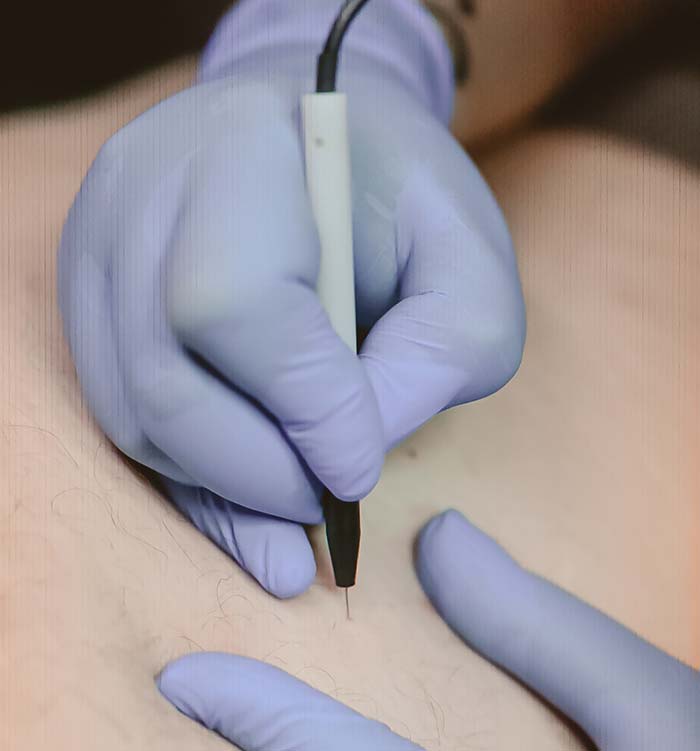
Thermolysis probe being used at Hideaway Spa
Three modalities
- Galvanic electrolysis: Uses direct current to produce a chemical (lye) reaction in the follicle. Very thorough but slow — each follicle takes 1–3 minutes. Effective but rarely used alone today due to time constraints.
- Thermolysis (what we use at Hideaway Spa): Uses high-frequency radiofrequency energy to produce targeted heat in the follicle. Much faster — seconds per follicle — with comparable results. Also referred to as shortwave or high-frequency electrolysis.
- Blend: Combines galvanic and thermolysis for enhanced follicle destruction. Slower than thermolysis alone but often cited as particularly effective for distorted follicles.
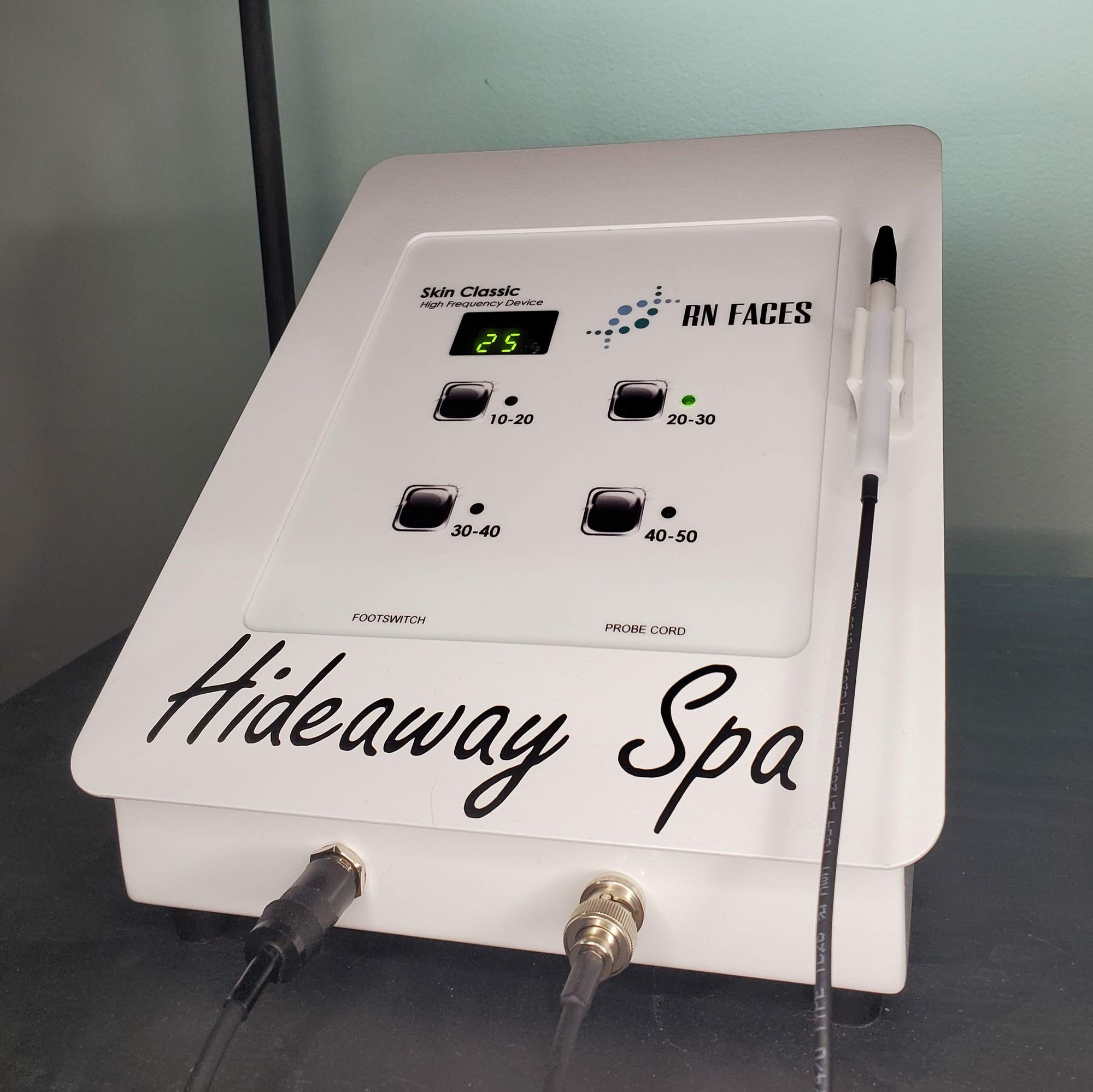
Skin Classic device used for thermolysis at Hideaway Spa
The critical advantage: works on any hair colour and skin tone
Because electrolysis/thermolysis doesn't rely on melanin contrast, it works on blonde, red, grey, and white hair — the hair types that laser simply cannot treat effectively. It also works safely on all Fitzpatrick skin types, including very dark skin, without the hyperpigmentation risk associated with inappropriate laser use.
The honest trade-off: time and area size
Treating follicles one by one means electrolysis is inherently slow. A small area like the upper lip or chin might take 20–30 minutes per session; clearing a larger area can require many hours of treatment spread over months or even years. This is exactly why it's ideally suited to small, well-defined spots — stray chin hairs, a few persistent brow hairs, or small areas of facial hair that aren't responding to laser.
At Hideaway Spa, I offer shorter thermolysis sessions (typically 10–20 minutes) specifically for small countable spots. I can also treat individual hairs as single blemishes from $50 — see my thermolysis page for details. While I don't personally treat large areas, electrolysis is technically possible at some practitioners who offer session blocks of 1–2 hours.
Pain level
Thermolysis produces a quick stinging or heat sensation with each follicle — more pronounced on sensitive facial areas. Most clients find it tolerable for short sessions on small spots. That said, it is not pleasant and is generally more uncomfortable than waxing.
Laser vs. electrolysis: which is more permanent?
Head-to-head comparisons consistently show electrolysis delivers superior long-term permanence compared to laser, particularly for facial and hormonally influenced hair.9 Laser offers faster treatment of large areas and meaningful reduction but is not classified as permanently removing hair — regrowth, especially finer regrowth, is expected over time. For the ultimate permanence on any hair colour, electrolysis wins. For covering large body areas efficiently, laser wins. Many people use both strategically.
Learn more about our thermolysis services (including blemish correction — skin tags, cherry angiomas, and more): Hideaway Spa Thermolysis & Blemish Correction →
I've personally used thermolysis on stray facial hairs with excellent results. The permanence is unbeatable for those small targeted spots — I haven't seen them return. It's a completely different experience from a full-body treatment plan, and I genuinely love offering it for clients who want that one or two persistent hairs gone for good.
Side-by-Side Comparison: All Major Hair Removal Methods
Scroll right on mobile to see all columns.
| Method | Results Last | Permanent? | Sessions | Approx. Cost (ON) | Pain Level | Best For | Skin/Hair Flexibility |
|---|---|---|---|---|---|---|---|
| Shaving | 1–3 days | No | Daily | Very low (ongoing) | Low | Quick touch-ups | All types |
| Depilatory Creams | Days–2 wks | No | As needed | Low (ongoing) | None (high irritation risk) | At-home convenience | Most (not sensitive skin) |
| Waxing | 3–6 weeks | No (finer regrowth over time) | Every 4–6 wks | $15–$95/session | Medium (improves with consistency) | Most people & areas; all hair colours | All skin & hair types |
| Sugaring | 3–5 weeks | No (finer regrowth over time) | Every 4–6 wks | Similar to waxing | Medium | Sensitive skin; natural-ingredient preference | All skin & hair types |
| Threading | 2–5 weeks | No | Every 3–5 wks | $10–$30/session (facial) | Medium (stinging sensation) | Eyebrow shaping & precise facial hair only | All skin & hair types; no chemicals or heat |
| Epilator | 2–4 weeks | No (finer regrowth over time) | Every 2–4 wks | Low (device cost + ongoing) | High (improves as hair thins) | At-home root removal; fine hair on legs/arms | All types — higher ingrown risk for coarse/curly hair |
| Laser | Months–years (reduction only; maintenance common) | Heavy reduction — 30–84% long-term depending on device & site9 | 6–8+ (more for hormonal areas) | $300–$3,000+ total course | Medium–High | Large areas; best for dark hair on lighter skin | Limited — not for light/grey/red/white hair; device choice critical for darker skin |
| Electrolysis / Thermolysis | Permanent (per treated follicle) | Yes — only FDA/HC-recognized permanent method11 | Many sessions; long course for larger areas | $50–$200+/session | Medium-High (individual sting per follicle) | Small targeted spots; all hair colours including grey/white/red | All skin & hair types — only method for light-coloured hair |
So Which Method is Right for You?
There's no single "best" method — it depends entirely on your goals, budget, skin/hair type, and how much of a long-term investment you want to make. Here's the honest framework I share with clients:
Choose waxing if…
- You want immediate, reliable smoothness for 3–6 weeks without a large upfront investment
- You have light, grey, red, or white hair (laser won't help much)
- You have darker skin and want to avoid hyperpigmentation risk
- You're looking for a budget-friendly method that works for all body areas
- You want a method that also exfoliates and progressively improves over time
Consider laser if…
- You have dark, coarse hair on fair-to-medium skin — this is the ideal laser candidate profile
- You're tired of shaving or waxing large areas (legs, back, underarms) and want long-term density reduction
- You're willing to commit to 6–10+ sessions over several months
- You understand the results will be reduction, not a guaranteed elimination — and you understand it may require occasional maintenance
- You're considering it even partially: even a few sessions to knock down density makes everything easier afterward
Choose electrolysis/thermolysis if…
- You have specific small areas you want gone permanently — a few random hairs that never go away
- You have light, grey, or red hair that laser can't treat
- You want true permanence, not just reduction
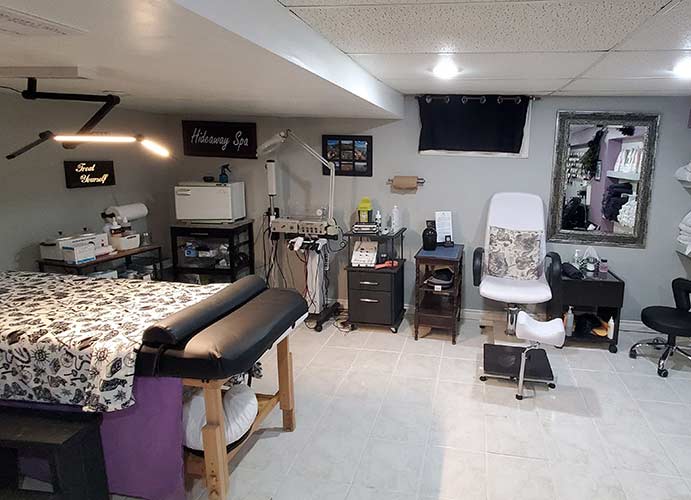
My treatment area at Hideaway Spa in Windsor, ON
Final Thoughts: Choosing the Right Hair Removal Method for You
Professional root-removal methods like waxing and sugaring remain excellent choices for immediate, long-lasting smoothness (typically 3–6 weeks). While they work on the same basic principle — pulling hair from the follicle — differences in ingredients, application direction, and gentleness make each better suited to different skin types and preferences. Waxing is often faster and more effective on coarser hair or larger areas, while sugaring appeals strongly to those with sensitive skin seeking a fully natural option. Many of my Windsor clients start with one of these two methods and later explore longer-term solutions like laser or thermolysis once they better understand their own hair growth patterns and tolerance.
Stay informed and set realistic expectations. No hair removal method is completely risk-free or works the same for everyone. Results depend heavily on your individual hair and skin type, consistency, and proper aftercare.
Most importantly, choose a practitioner who is properly trained, experienced, and transparent. Skilled technique makes a significant difference in comfort, safety, and long-term outcomes. When you understand the science behind each method and work with someone who truly knows what they’re doing, you’re far more likely to be happy with your results.
The honest truth is that most people end up combining methods over time — waxing while they figure out their skin, laser to reduce density in a stubborn area, thermolysis to finish off the few hairs that won't quit. The temporary methods will always compete with each other on convenience, cost, and personal preference — but none of them are truly in competition with laser or electrolysis, because they're solving different problems. The right approach is the one that fits your hair type, your skin, your budget, and your life — and whichever route you choose, consistency is what turns a good method into a great result.
Ready for Smooth Skin?
Whether you're brand new to waxing or trying to figure out the right long-term strategy for your hair removal goals, I offer a full consultation with every first-time appointment — no pressure, just honest professional advice tailored to your skin, hair type, and lifestyle.
Hideaway Spa is an inclusive spa. All genders, all body types welcome with equal pricing.
References & Scientific Literature
- Buffoli B, Rinaldi F, Labanca M, et al. The human hair: from anatomy to physiology. Int J Dermatol. 2014;53(3):331–341. Overview of hair cycle phases and body-site-specific anagen duration estimates.
- Evans RL, Bates S, Marriott RE, Arnold DS. The impact of different hair-removal behaviours on the biophysical and biochemical characteristics of female axillary skin. Int J Cosmet Sci. 2020;42(5):436–443. doi:10.1111/ics.12648. — Shaving caused significantly greater skin dryness than waxing or plucking; all three methods elevated IL-1α and IL-1RA; waxing caused more immediate erythema than shaving.
- Lynfield YL, Macwilliams P. Shaving and hair growth. J Invest Dermatol. 1970;55(3):170–172. doi:10.1111/1523-1747.ep12260492. — Classic controlled study demonstrating shaving has no effect on hair shaft width, colour, or growth rate.
- Burnett CL, Heldreth B, Bergfeld WF, et al. Safety assessment of thioglycolic acid and its salts as used in cosmetics. Int J Toxicol. 2019;38(1_suppl):5S–36S. — Comprehensive review of thioglycolate chemistry in depilatory products and documented irritation and skin injury profiles.
- Cleveland Clinic. Shaving vs. Waxing: Benefits, Cons and Results. August 30, 2024.
- Martincigh BS, Baruchello R. The impact of different hair-removal behaviours on the biophysical parameters of skin. Int J Cosmet Sci. 2021;43(1):3–17. — Documents progressive reduction in hair density with repeated waxing and relative changes in follicle dimensions over time.
- Vashi NA, et al. Lasers for reduction of unwanted hair in skin of colour: a systematic review and meta-analysis. J Eur Acad Dermatol Venereol. 2020;34(5):948–955. doi:10.1111/jdv.15995. — For Fitzpatrick III–VI skin types, long-pulsed Nd:YAG laser showed more favourable safety vs IPL; Alexandrite superior to IPL for hair count reduction; overall trend favours true lasers over IPL.
- Health Canada. It's Your Health: Cosmetic Laser Treatments (updated 2021). — Official consumer advisory stating laser may achieve "about 30%" permanent hair reduction, with no guarantees.
- Krasniqi A, McClurg DP, Gillespie KJ, Rajpara S. Efficacy of lasers and light sources in long-term hair reduction: a systematic review. J Cosmet Laser Ther. 2022;24(1–5):1–8. doi:10.1080/14764172.2022.2075899. — Systematic review of RCTs; Nd:YAG 30–73.6%, Alexandrite 35–84.3%, Diode 32.5–69.2%, IPL 27–52.7% long-term reduction; highest reduction for leg hair (1-year cycle), lowest for facial hair.
- Kelsall D (editorial). Laser hair removal: No training required? CMAJ. 2010;182(8):743. doi:10.1503/cmaj.100475. — Documents absence of provincial licensing requirements for laser hair removal operators in Canada; underscores importance of operator training.
- HealthLinkBC. Electrolysis for Removing Hair. — "When electrolysis is done correctly, it permanently removes unwanted hair." Aligned with FDA classification of electrolysis as the only method of permanent hair removal.
- DeMaria AL, Flores M, Hirth JM, Berenson AB. Complications related to pubic hair removal. Am J Obstet Gynecol. 2014;210(6):528.e1–5. — Folliculitis rates ~7.2% in waxing group with suboptimal post-care; emphasizes importance of aftercare protocol.
- Vashi NA, et al. Hair removal practices: mechanisms of follicular disruption and ingrown hair formation. Described in the dermatology literature as arising from two primary pathways: (1) sub-surface hair breakage due to incomplete mechanical extraction, and (2) follicular occlusion from absent exfoliation. The epilator mechanism is discussed in the context of comparative hair removal methods. See also: DeMaria et al. (2014, ref-12) for folliculitis pathways common across mechanical extraction methods.
- J.I Group. A Study on the Waxing Effectiveness of Sugaring. Comparative clinical trial on skin condition and ingrown hair rates after sugar vs hard waxing. (Results showed higher inflammation and ingrown hairs with sugaring in some cases; aftercare noted as critical.)
- Kollapudi SA et al. Dermatoses Occurring after Parlor Procedures. Indian Dermatol Online J. 2021;12(2):198-205. — Common side effects of threading include erythema, folliculitis, molluscum contagiosum, and verruca plana, often linked to hygiene and technique.
- Snast I, Kaftory R, Lapidoth M, Levi A. Paradoxical hypertrichosis associated with laser and light therapy for hair removal: a systematic review and meta-analysis. Am J Clin Dermatol. 2021;22(5):615-624. doi:10.1007/s40257-021-00611-w. PubMed
Disclaimer: This article is for informational purposes only and should not replace professional advice. Always consult with a qualified esthetician or healthcare provider about your specific skin type, hair type, and individual needs before beginning any hair removal regimen.
Republishing Policy: You are welcome to quote or repost excerpts from this article with proper credit and a direct link back to the original at https://windsorskinwitch.ca/blog/hair-removal-guide
Please do not republish the entire article without linking back to the source.
Related Reading
- Waxing Aftercare Guide: What the Science Actually Says About Preventing Ingrown Hairs →
- The Rise of Men's Waxing: Breaking Stereotypes in 2026 →
- Everything You Need to Know About Brazilian Waxing →
- Waxing Services at Hideaway Spa →
- Counterfeit Laser Devices in Canadian Clinics: What Health Canada's Warning Means →
- See our Brow and Lash Services →
- Thermolysis & Blemish Correction at Hideaway Spa →