Executive Summary
A question came up in the South Windsor Watch Facebook group that I felt was worth addressing: "Has anyone done Ultherapy that's over 50 to 55? How were your results? Would you recommend it?" It's a smart question, and the honest answer is more nuanced than the ads suggest. Ultherapy (micro-focused ultrasound with visualization, or MFU-V) is an FDA-cleared, evidence-backed option for non-surgical lifting — but peer-reviewed data consistently shows results are real yet modest: a refreshed, firmer look rather than a dramatic overhaul.
Microneedling (including microchanneling) works at an entirely different tissue level — targeting texture, scars, tone, and surface-level collagen rather than deep structural lift. The two treatments aren't really competing; they just answer different questions your skin is asking.
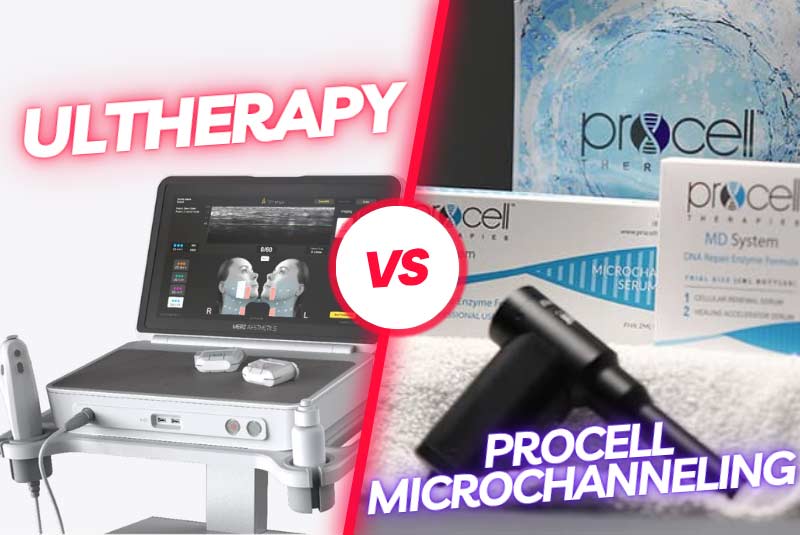
TL;DR: The quick facts
- Ultherapy uses focused ultrasound to reach deep structural layers (including the SMAS — the same layer a surgeon targets in a facelift). It produces real but subtle lift and tightening. Best for mild-to-moderate laxity; results are more modest in 50s+ as fibroblast capacity declines. One session, $800–$4,000+, takes 3–6 months to show fully.
- Procell Microchanneling creates precision micro-channels and infuses medical-grade recombinant growth factor serums directly into the dermis. It boosts collagen production, visibly improves texture, tone, scarring, and glow — and yes, produces a real degree of lift and firmness over a series. 83% patient satisfaction in clinical research; 93.8% reported wrinkle improvement in a trial with an average patient age of 56. Series of 3–6 sessions spaced 4 weeks apart. $350 per single face session or $1,250 for the recommended 4-session bundle. Minimal downtime (a few hours of pinkness).
- In reality they act on different layers of the skin. Ultherapy targets significant deep structural laxity at the SMAS level for a lifting effect. Microchanneling primarily works in the dermis to improve surface quality, texture, and moderate firmness through collagen stimulation and growth factors. Many clients see the best overall results by combining both treatments. We offer microchanneling at Hideaway Spa; Ultherapy requires medical-level equipment and is offered elsewhere.
What Is Ultherapy and How Does It Work?
Ultherapy is the brand name for micro-focused ultrasound with visualization (MFU-V), the only ultrasound device currently FDA-cleared for non-invasive lifting of the brow, neck, and under-chin, as well as reducing lines and wrinkles on the décolletage.1 The "with visualization" part is important — the built-in ultrasound imaging lets the practitioner see the tissue layers being targeted in real time before delivering energy.
The technology works by firing focused pulses of ultrasound energy to create tiny, precise thermal coagulation points (TCPs) at specific depths below the skin's surface — without disrupting the epidermis at all. Temperatures at each TCP typically reach 60–70°C, which is hot enough to cause controlled collagen denaturation.2 This triggers the body's natural wound-healing cascade: macrophages clean up the injured tissue, fibroblasts are recruited, and over the following weeks and months, new Type I and Type III collagen is laid down in a tighter, more organized architecture.3
The deepest transducer can reach 4.5 mm — the depth of the SMAS, the same fibromuscular layer a surgeon plicates during a traditional facelift. Reaching the SMAS non-invasively is what makes Ultherapy unique among energy devices and theoretically capable of producing a lifting (not just tightening) effect.
Where Each Treatment Works in the Skin
| Skin Layer | Approx. Depth | Treatment Reaching This Layer |
|---|---|---|
| Epidermis | 0–0.1 mm | Microchanneling — access point for serums |
| Superficial Dermis | 0.1–1.5 mm | Microchanneling + growth factor infusion |
| Reticular Dermis | 1.5–3 mm | Ultherapy (3.0 mm transducer) |
| Hypodermis / Subcutaneous | 3–5 mm | Ultherapy (4.5 mm transducer) |
| SMAS Layer | ~4.5 mm+ | Ultherapy only |
Depths are approximate and vary by anatomical region and individual anatomy.
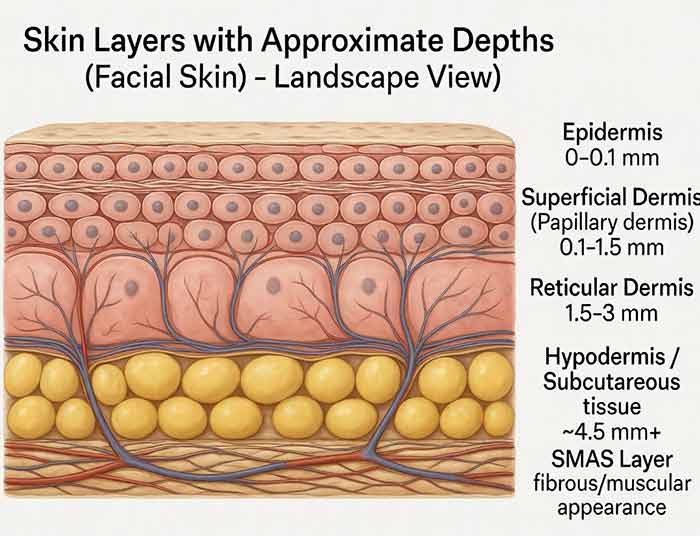
Diagram showing skin layers
What It's Cleared (and Not Cleared) to Do
It's worth being precise here, because marketing language can blur the lines. The FDA clearance covers the brow, submental area (under-chin), and neck for lifting, and the décolletage for wrinkle improvement. Off-label applications — jawline, mid-face, abdomen, arms — are common in practice but the regulatory approval doesn't extend there. This doesn't mean off-label use is unsafe or ineffective, just that the evidence base is stronger for the cleared areas.
What Does the Science Actually Show? Realistic Results
A 2025 systematic review and meta-analysis — the most comprehensive to date — analyzed 42 studies covering over 4,000 references published through 2023. The pooled findings were encouraging but measured:4
- 89% of patients showed some degree of global aesthetic improvement as assessed by investigators.
- 84% of patients reported subjective improvement following treatment.
- Satisfaction of any level was reported by 84% of patients — but this dropped to 62% when "neutral" was offered as a response option, suggesting a meaningful portion feel the change is too subtle to qualify as clearly positive.
A separate 2023 systematic review of 16 studies specifically measuring objective lift found measurable but modest numbers: brow lift results ranged from 0.47 to 1.7 mm, and submental area reductions measured as a 26–45 mm² reduction on lateral photographs.5 These are real, clinically detectable changes — but to put them in perspective, 1 mm of brow lift is something a blinded physician can measure in a photo, not necessarily something a client will notice in the mirror every morning.
Results build gradually over 3–6 months as new collagen matures and can last 12–24 months in suitable candidates.4 Most practitioners recommend repeating the treatment every 12–18 months to maintain results.
Safety Profile
Across more than 100 published studies, Ultherapy has a well-established safety record. The most common side effects are temporary redness, swelling, tenderness, and tingling — typically resolving within days. More significant complications (bruising, nerve effects, focal fat loss) have been reported rarely in the literature, most often tied to incorrect transducer depth selection or treatment over at-risk anatomical areas.4 In the hands of properly trained practitioners, serious adverse events are uncommon.
The 50+ Question: Why Age Matters More Than You Might Think
Here's the part of the Ultherapy conversation that's often glossed over in marketing: the treatment relies entirely on your own fibroblasts to produce the new collagen. And fibroblast function declines meaningfully with age.
A landmark study by Varani et al. demonstrated that type I procollagen production by dermal fibroblasts isolated from older skin (80+ years) was measurably lower than that from young skin (18–29 years) — and that both cellular aging and reduced mechanical stimulation from fragmented collagen matrix contribute to this decline.6 A related paper from Fisher et al. describes how this becomes a self-perpetuating cycle: fragmented collagen prevents fibroblasts from receiving the mechanical signals they need to produce new collagen, accelerating the very process that caused the problem.7
What this means practically: a 35-year-old and a 58-year-old receiving identical Ultherapy treatments will have different biological responses, because their fibroblasts are at different points on that curve. This doesn't mean Ultherapy doesn't work in mature skin — studies include patients in their 50s and 60s with meaningful results — but it does mean expectations should be calibrated accordingly. Most clinical data suggests that ideal candidates have mild-to-moderate laxity; more advanced sagging tends to show smaller gains.8
For clients over 50 asking whether Ultherapy is "worth it": the evidence says it can deliver real improvement, with the caveat that results will be subtler than at a younger age and individual biology matters enormously. A in-person consultation with the practitioner (not just a sales coordinator) is essential to setting realistic goals.
View PRP Microneedling & Vampire Facials vs Procell Microchanneling for more details →
Microchanneling with Recombinant Growth Factor Serums: A Different Tool for a Different Job
Microchanneling is a refined evolution of traditional microneedling. Where standard microneedling uses a roller or motorized pen that drags or oscillates needles across the skin, microchanneling uses a precision stamping device that creates uniform, vertical micro-channels with minimal lateral tissue trauma. At Hideaway Spa, we use the Procell Therapies system.
The mechanism is collagen induction therapy: the controlled micro-injuries trigger a wound-healing cascade that produces new collagen and elastin in the treated tissue. Studies have found significant histological improvements in collagen bundle organization, epidermal thickness, and elastic fiber density following a course of microneedling treatments.9
What Does the Evidence Say About Patient Outcomes?
There are no published clinical trials specifically on Procell microchanneling as a branded system — so I want to be transparent about that upfront. However, microchanneling is a precision evolution of microneedling, and the broader microneedling literature is extensive and reassuring. A 2025 systematic review (Foppiani et al., Aesthetic Plastic Surgery) covering 21 studies and 723 patients undergoing microneedling for facial rejuvenation found a pooled patient satisfaction rate of 83% (95% CI: 0.76–0.88) across all trials.13 A separate FDA-registered clinical trial (Alqam et al., Journal of Cosmetic Dermatology 2023) had patients complete four monthly professional microneedling sessions: 93.8% reported improvement in wrinkles, 87.5% were satisfied with the treatment procedure overall, and 80.6% said they would recommend it to friends and family.14 Significant improvements were measurable as early as 30 days after the first session. The average patient age in that trial was 56.3 years — making this data directly relevant to the 50+ conversation.
Why Add Recombinant Growth Factor Serums?
Growth factors are signaling proteins — EGF, bFGF, TGF-β, PDGF, and others — that instruct skin cells to repair, regenerate, and produce collagen. The catch: growth factor molecules are large (typically >15,000 kDa) and cannot penetrate the stratum corneum through normal topical application. Microchanneling solves this. The micro-channels temporarily breach the skin barrier, creating direct pathways into the dermis where fibroblasts are actively being recruited.10
A randomized controlled split-face trial published in the Journal of Drugs in Dermatology found that the addition of topical growth factors to microneedling produced significantly greater improvement in skin texture, fine lines, and wrinkles compared to microneedling alone — with a statistically significant result on the Fitzpatrick Wrinkle Scale.10
A published split-face study by El-Domyati et al. compared microneedling alone to microneedling combined with amniotic-fluid-derived mesenchymal stem cell conditioned media. The combination arm showed mean improvement of 60.6% vs. 33.2% for microneedling alone — a near-doubling — with superior histological remodeling of dermal collagen and elastic fibers.11
The Procell Therapies serums used at Hideaway Spa are lab-formulated growth factor blends designed to support the skin’s natural repair response following microchanneling. The key advantage for mature skin: you're supporting the skin’s regenerative signaling externally, helping to enhance collagen production despite the natural decline in fibroblast activity that comes with age.
Learn more about microneedling serums →What Microchanneling Is Best At
- Improving skin texture and surface smoothness
- Reducing the appearance of acne scars and other textural scarring
- Targeting fine lines and wrinkles at the dermal level
- Evening out skin tone and reducing pore appearance
- Improving overall skin glow and radiance ("that dewy, bouncy skin" my clients always describe)
- Providing noticeable, visible results after a series of treatments
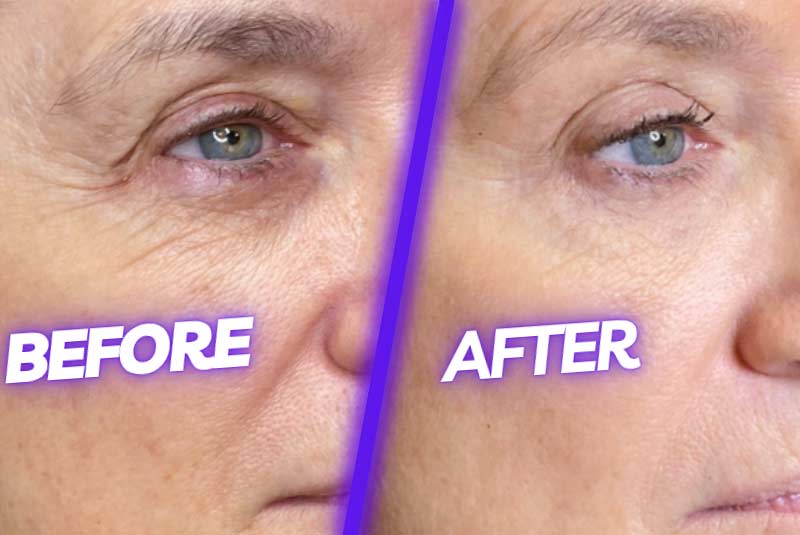
Before and after showing facial lift from Procell treatments
One thing I want to be clear about — because this article could give the wrong impression — is that microchanneling does contribute to lift. Collagen is the scaffolding that holds skin up. As a series of treatments rebuilds collagen density in the dermis, many clients do see a visible improvement in firmness and a degree of lift — I have before-and-after photos from my own clients that show exactly this. What microchanneling doesn't do is reach the SMAS layer, so it won't replicate the deeper structural repositioning Ultherapy targets. The distinction is one of degree and mechanism, not lift versus no lift. If your concern is significant jowling or pronounced neck laxity, Ultherapy addresses that more directly. If your laxity is mild to moderate, microchanneling's collagen-rebuilding effect may produce meaningful visible improvement in firmness on its own.
Side-by-Side Comparison
💰 A Note on Cost
This is often the deciding factor — and the gap is significant.
Ultherapy
Single session; typically repeated every 12–18 months. Oral pain relief often needed and may add cost. Prices vary significantly by provider and city.
Microchanneling at Hideaway Spa
Significantly more accessible per session. Most clients do a series for best results, with individual sessions a fraction of a single Ultherapy treatment. View our current pricing →
For many clients, a full microchanneling series costs less than a single Ultherapy session — while targeting completely different (and often more visible day-to-day) concerns.
| Aspect | Ultherapy (MFU-V) | Microchanneling + Growth Factor Serums |
|---|---|---|
| Mechanism | Focused ultrasound creates thermal coagulation points at precise depths in the reticular dermis, hypodermis, and SMAS | Precision stamping creates micro-channels; recombinant growth factor serum is infused directly into the dermis |
| Primary Target | Deep structural layers (3.0–4.5 mm depth, incl. SMAS) | Superficial dermis and epidermis (0.25–1.5 mm) |
| Primary Goal | Lifting and tightening of brow, neck, under-chin, and décolletage | Texture improvement, scar reduction, tone, glow, and surface-level collagen induction |
| Lifting Ability | Yes — brow lift of 0.47–1.7 mm documented; submental area reduction documented in clinical studies | Minimal structural lift — not the right tool for significant laxity |
| Texture & Glow | Secondary benefit — some improvement in skin quality noted in studies | Primary benefit — often visible within days of first treatment; improves with series |
| Patient Satisfaction (Clinical Data) | 89% show some investigator-assessed improvement; ~62% describe clearly positive satisfaction when "neutral" is an option (meta-analysis, 42 studies) | 83% pooled satisfaction across 723 patients (systematic review, 2025); 93.8% reported wrinkle improvement in a dedicated clinical trial (avg. age 56) |
| Impact of Age on Results | Relies on your own fibroblast response — declines with age. Results typically more modest in 50s+ than in 30s–40s | Supplies external growth factors — partially compensates for age-related decline in endogenous signaling |
| Downtime | Zero to minimal — redness and tenderness for hours to a day or two | Very minimal with Procell microchanneling — the precision stamping technique causes significantly less tissue trauma than traditional microneedling. Most clients are lightly pink for a few hours; the majority are comfortable resuming normal activities the same day or evening |
| Number of Sessions | Typically 1 session; repeated every 12–18 months to maintain | Series of 3–6 treatments, 4–6 weeks apart, for optimal results |
| Result Longevity | The new collagen and lift are long-lasting but not permanent. Results typically last 1–2 years on average (sometimes longer). Many clients repeat every 12–18 months as natural aging continues. | The improvements in collagen, texture, firmness, tone, and glow are long-lasting and essentially permanent once the series is complete. Any future softening comes only from continued natural aging. |
| Cost | $800–$4,000+ per session depending on area(s) treated — see pricing note above | Significantly more accessible; $325 per session, $1100 for a package of 4. See Hideaway Spa's current pricing |
| Pain Level | Moderate — most clinics offer topical anesthesia and/or oral pain relief; described as intense tingling or heat sensations | Low to mild — typically tolerated without topical anesthesia by most clients |
| Available at Hideaway Spa? | No — requires medical-grade equipment and certification beyond esthetics scope | Yes — we offer professional Procell microchanneling with recombinant growth factor serums |
| Complementary? | Yes — many clients combine both. Ultherapy lifts from deep; microchanneling refines the surface. They operate at different tissue depths and address different concerns. | |
Key Takeaways
- Ultherapy is real science, not hype — but results are genuinely subtle. The evidence is solid across 42 studies. Measurable brow lift, documented submental tightening. But "measurable" by a blinded clinician in a photograph and "dramatic" are not the same thing. Expect a refreshed, firmer version of yourself — not a decade younger overnight.
- Age matters — specifically your fibroblast biology. Ultherapy stimulates your body's own collagen response. Because fibroblast activity and collagen synthesis capacity decline with age, results in clients over 50–55 with moderate-to-significant laxity are typically more modest than in clients with mild laxity in their 40s. This is biology, not a flaw in the device.
- Microchanneling lifts too — just through a different mechanism and at a different scale. By rebuilding dermal collagen density over a series of treatments, microchanneling does produce a visible improvement in skin firmness and lift for many clients. The difference from Ultherapy is depth and degree: Ultherapy targets the SMAS layer specifically for structural repositioning, making it the stronger choice for significant laxity. Microchanneling is the stronger choice when your primary concerns are texture, tone, scarring, glow, and moderate firmness improvement — and for mild-to-moderate laxity, the collagen induction alone may be all you need.
- Recombinant growth factors are a meaningful upgrade. The combination of microchanneling with high-potency growth factor serums consistently outperforms microneedling alone in clinical research — and is especially relevant for mature skin where endogenous signaling is reduced. Learn more about microneedling serums →
- They're complementary, not competing. Some clients who want both structural tightening and surface refinement pursue Ultherapy for the lift and microchanneling for the glow. Both can coexist in a smart treatment plan.
Final Thoughts from Erika
The Facebook question — "Has anyone done Ultherapy over 50? Was it worth it?" — doesn’t have a single right answer. It really depends on your specific skin laxity, what “worth it” means to you, and how your body responds to collagen stimulation.
Some clients are thrilled with the subtle lift and tightening they get from Ultherapy. Others feel the results were too modest for the cost, time, and discomfort involved. Both experiences are valid and reflect what the clinical data shows: Ultherapy can produce real improvement in mild-to-moderate laxity, but the results are often subtle, especially in clients over 50 as fibroblast activity naturally declines.
If your main concerns are texture, tone, scarring, pore size, dullness, or an overall tired-looking complexion, Procell Microchanneling with stem-cell growth factor serums tends to deliver more visible and satisfying improvements in those areas — and we offer that here at Hideaway Spa in Windsor.
If you’re considering Ultherapy, I’d strongly recommend a thorough consultation with a qualified provider. Ask to see before-and-after photos of patients in your age group with similar laxity, and go in with realistic expectations about the degree of lift you can expect. Many people also choose to combine Ultherapy (for deeper lifting) with microchanneling (for surface refinement and glow) for better overall results.
References & Scientific Literature
- U.S. Food & Drug Administration. 510(k) clearance for Ulthera System (Ultherapy). FDA Database. Cleared for non-invasive lifting of brow, submental, and neck tissue and improving décolletage lines and wrinkles. FDA Device Database.
- Fatemi A, et al. New Ultherapy method: Utilizing novel surgical and anatomical concepts yields outstanding results. J Cosmet Dermatol. 2024. The paper notes that optimal collagen shrinkage occurs at 57–61°C, while MFU-V creates TCPs in the 60–70°C range at targeted points, leaving surrounding tissue intact.
- Pavicic T, et al. Microfocused Ultrasound With Visualization in Skin Quality: A Narrative Review. J Cosmet Dermatol. 2025. Reviews the three-phase wound-healing mechanism: inflammatory phase (macrophage recruitment), proliferation phase (Type III collagen synthesis by fibroblasts), and maturation phase (replacement by Type I collagen with cross-linking).
- Bloom JD, et al. Microfocused Ultrasound With Visualization (MFU-V) Effectiveness and Safety: A Systematic Review and Meta-Analysis. Aesthetic Surgery Journal. 2025. The most comprehensive meta-analysis to date, including 42 studies and 4,019 references through 2023. Reported 89% investigator-assessed improvement, 84% patient-reported improvement, and 62% clearly positive satisfaction when "neutral" was offered as a response option.
- Contini M, Hollander MHJ, Vissink A, Schepers RH, Jansma J, Schortinghuis J. A Systematic Review of the Efficacy of Microfocused Ultrasound for Facial Skin Tightening. Int J Environ Res Public Health. 2023;20(2):1522. Documented brow lift of 0.47–1.7 mm and submental area reduction of 26–45 mm² on lateral photographs across 16 eligible studies.
- Varani J, Dame MK, Rittie L, et al. Decreased Collagen Production in Chronologically Aged Skin: Roles of Age-Dependent Alteration in Fibroblast Function and Defective Mechanical Stimulation. Am J Pathol. 2006;168(6):1861–1868. Demonstrated that type I procollagen production by fibroblasts from older skin (80+) was statistically significantly lower than from young skin (18–29), establishing both cellular aging and reduced mechanical stimulation as contributing mechanisms.
- Fisher GJ, Shao Y, He T, et al. Looking older: fibroblast collapse and therapeutic implications. Arch Dermatol. 2008;144(5):666–672. Describes the self-perpetuating cycle of collagen fragmentation → fibroblast collapse → reduced collagen synthesis → further fragmentation in aged skin.
- Khan U, Khalid N. A Systematic Review of the Clinical Efficacy of Microfocused Ultrasound Treatment for Skin Rejuvenation and Tightening. Cureus. 2021;13(12):e20163. Reviewed studies in patients aged 35–65, noting that the SMAS is an effective target for non-invasive tightening but that best results are observed in patients with mild-to-moderate laxity.
- El-Domyati M, et al. Facial rejuvenation using stem cell conditioned media combined with skin needling: A split-face comparative study. J Cosmet Dermatol. 2022. Published split-face data showing histological improvements in collagen bundle organization, epidermal thickness, and elastin fiber structure following a course of microneedling treatments. Referenced in Dermatology Times.
- Kaminaka C, et al. An Assessment of Microneedling with Topical Growth Factors for Facial Skin Rejuvenation: A Randomized Controlled Trial. J Drugs Dermatol. 2020. Found that growth factor addition to microneedling produced significantly greater improvement in texture, hydration, and wrinkle parameters than microneedling alone. Reviews the molecular basis for why micro-channels are necessary for large growth-factor molecules (>15,000 kDa) to penetrate the stratum corneum.
- El-Domyati M, et al. Facial rejuvenation using amniotic-fluid-derived mesenchymal stem cell conditioned media combined with skin needling: Split-face comparative study. J Cosmet Dermatol. 2022. Mean clinical improvement of 60.6% on the combination side versus 33.2% on the microneedling-alone side after five sessions, with superior histological remodeling. Summarized in Dermatology Times.
- Du Y, Zheng H, Zhao F, et al. Efficacy of Microneedling Combined With Local Application of Human Umbilical Cord-Derived Mesenchymal Stem Cells Conditioned Media in Skin Brightness and Rejuvenation: A Randomized Controlled Split-Face Study. Front Med (Lausanne). 2022;9:837332. Found significantly greater physician-assessed improvement in brightness and skin texture with the stem-cell conditioned media combination versus microneedling alone (P < 0.05).
- Foppiani JA, Fanning JE, Beltran K, et al. Microneedling for Facial Rejuvenation: A Systematic Review. Aesthetic Plast Surg. 2025. Included 21 studies and 723 patients undergoing microneedling for facial rejuvenation (average age 48 years; 72% female). Pooled proportion meta-analysis found 83% patient satisfaction (95% CI: 0.76–0.88). The most common treatment endpoints were wrinkling (71%), skin texture (33%), and photoaging (29%). 90% of trials treated patients with multiple sessions.
- Alqam M, Wamsley CE, Hitchcock TM, Jones BC, Akgul Y, Kenkel JM. Efficacy and tolerability of a microneedling device for treating wrinkles on the face. J Cosmet Dermatol. 2023;22(1):206–213. FDA-registered clinical trial (NCT03803059); 35 healthy adults (mean age 56.3 years) received four monthly professional microneedling sessions. Patient satisfaction questionnaire found 93.8% reported improvement in wrinkles, 87.5% satisfaction with the treatment procedure, and 80.6% would recommend microneedling to friends and family. Significant improvements were measurable at 30 days post-procedure.
Disclaimer: This article is for informational purposes only and does not constitute medical advice. Individual results vary considerably based on skin condition, age, biology, and treatment parameters. A personalized in-person consultation with a qualified practitioner is always recommended before pursuing any aesthetic procedure.
Republishing Policy: You are welcome to quote or repost excerpts from this article with proper credit and a direct link back to the original at https://windsorskinwitch.ca/blog/ultherapy-vs-microchanneling
Please do not republish the entire article without linking back to the source.
Related Reading
- Learn More About Microneedling/Microchanneling →
- Microneedling Serums Compared: Growth Factors, PRP, PDRN & Exosomes
- The Hidden Dangers of RF Microneedling →
- Skin Rejuvenation Guide - Chemical Peels, Needling & More →
- Benefits of High Frequency and Galvanic Treatments →
- Counterfeit Laser Devices in Canadian Clinics: What Health Canada's Warning Means →
- Scar Treatment Guide →
- Fall Skin Repair: Why Fall Is a Practical Window for Microneedling →
- Facial Services at Hideaway Spa →
- Thermolysis & Blemish Correction at Hideaway Spa →