Executive Summary
If you're short on time, here's the essentials: wildfire smoke from northwestern Ontario has pushed Windsor and most of Southern Ontario into red-level air quality warnings this week, with Detroit ranking among the most polluted major cities in the world. But smoke is really just the acute, headline-making version of a problem our air quality creates year-round — the same fine particulate matter (PM2.5) shows up, in smaller doses, from bridge traffic, industry, and ordinary urban pollution, so most of what's below is worth knowing whether or not there's smoke in the forecast. Here's what it does to skin: it triggers oxidative stress, breaks down the barrier protein filaggrin, and accelerates collagen loss. The result: dryness, irritation, flare-ups of eczema/rosacea/psoriasis (sometimes with a delay of weeks), and a head start on fine lines. Skip to What Actually Helps below for the routine changes, or keep reading for the full picture.
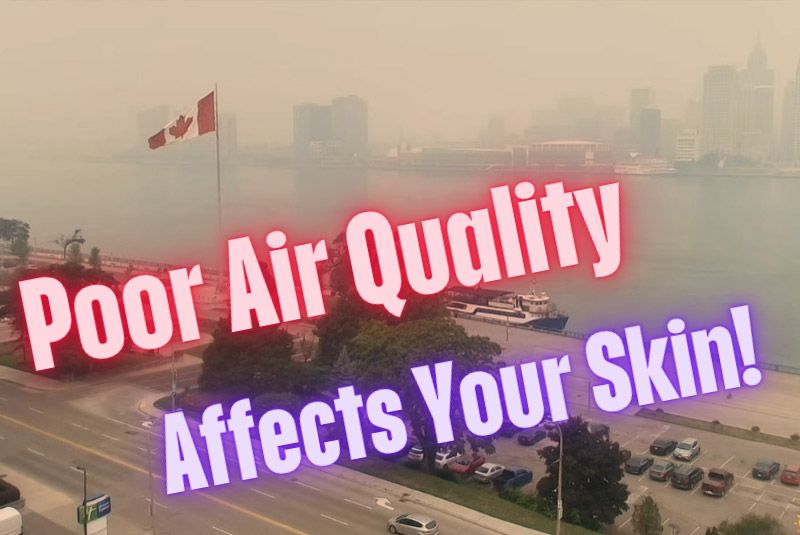
Your Skin Is an Exposed Organ, and Smoke Doesn't Skip It
Note: the mechanism below applies to fine particulate matter (PM2.5) generally, whatever its source — wildfire smoke, traffic exhaust, industrial emissions, or dust events. Wildfire smoke tends to bring a heavier, more concentrated dose, which is why it's the sharpest example, but the biology is the same on any high-pollution day.
Wildfire smoke is loaded with fine particulate matter — PM2.5, meaning particles smaller than 2.5 micrometers — along with a cocktail of gases and irritants. These particles are small enough to settle into pores and even penetrate the outer skin barrier. Once there, they trigger oxidative stress, essentially flooding skin cells with reactive molecules the skin isn't equipped to handle in large quantities.
How the Particles Actually Get In
A large part of what makes wildfire smoke's PM2.5 skin-relevant, rather than just lung-relevant, comes down to what it's carrying: polycyclic aromatic hydrocarbons, or PAHs, formed from burning organic material. PAHs are lipophilic — fat-loving — which means they move easily through the lipid-rich outer layer of skin rather than being blocked by it the way water-based irritants often are. That's the entry point.
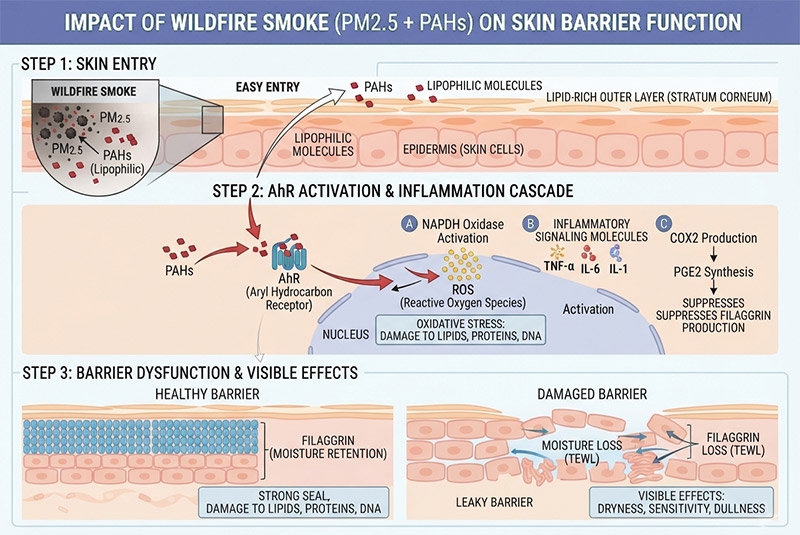
Diagram of smokes impact on the skin barrier (click to open in new window)
What Happens Once It's In: The AhR Pathway
Once inside, PAHs and other pollutant compounds bind to a receptor inside skin cells called the aryl hydrocarbon receptor (AhR). Under normal circumstances, AhR is a fairly ordinary part of how skin cells regulate their own genes. But when it's activated by pollutant compounds, it moves into the cell's nucleus and switches on a cascade of effects: it ramps up reactive oxygen species (ROS) production through an enzyme system called NADPH oxidase, and it triggers the release of inflammatory signaling molecules like TNF-α, IL-6, and IL-1.1
That ROS surge is where "oxidative stress" stops being an abstract phrase and starts being a mechanism — the excess reactive molecules damage lipids, proteins, and even DNA inside skin cells, which is what shows up on the surface as dryness, sensitivity, and dullness.
Why Filaggrin Keeps Coming Up
Filaggrin is one of the more important proteins for skin barrier function — it's essentially part of the "mortar" that keeps your outer skin layer tightly sealed and able to retain moisture. Lab research has traced a fairly specific chain of events for how PM2.5 knocks filaggrin down: AhR activation increases an enzyme called COX2, which produces a compound called PGE2, and PGE2 directly suppresses filaggrin production in skin cells.2 Less filaggrin means a leakier barrier, which means more moisture loss and easier entry for allergens and irritants — a feedback loop that makes skin progressively more reactive the longer exposure continues.
This isn't just a lab finding, either. One study comparing people who moved between a low-PM2.5 city (Denver) and a high-PM2.5 city (Seoul) found measurably lower levels of filaggrin breakdown products in skin samples taken while living in the higher-pollution environment — real-world evidence that this pathway plays out in actual human skin, not just cell cultures.3
Two Other Mechanisms Worth Knowing
- Inflammatory signaling doesn't stop at one pathway. Alongside AhR, PM2.5 activates NF-κB and MAPK signaling — two of the body's central inflammatory switchboards — which is part of why pollutant exposure tends to aggravate several different inflammatory skin conditions at once rather than just one specific one.4 In psoriasis specifically, researchers have identified a related pathway (KRT17/AKT/mTOR) through which PM2.5 promotes the kind of skin cell overproliferation that drives psoriatic plaques.
- Aging happens one layer deeper. While keratinocytes (the outer skin cells) are dealing with barrier breakdown, the fibroblasts living deeper in the skin are responding to the same oxidative and inflammatory signals by producing more matrix metalloproteinases (MMPs) — enzymes that break down collagen and elastin — while also slowing new collagen production.5 That combination is a large part of why chronic pollutant exposure is linked to premature fine lines, sagging, and pigmentation over time, separate from UV damage.
The practical result of all of this: dryness, irritation, faster visible aging, and flare-ups of existing skin conditions — not because of one single mechanism, but because PM2.5 hits the skin from several directions at once.
The Research Backs This Up
The clearest evidence comes from California's 2018 Camp Fire. Researchers at UC San Francisco tracked 8,049 dermatology visits from 4,147 patients before, during, and after the fire and found a real spike in appointments for eczema (atopic dermatitis) and itch during the smoke-heavy weeks.6 A 10 µg/m³ increase in weekly PM2.5 was associated with a 7.7% rise in pediatric itch clinic visits, and pediatric itch visit rates nearly doubled during wildfire weeks compared to normal periods.
Maybe the most striking detail: among adults who came in with itch during the Camp Fire, 89% had no prior diagnosis of atopic dermatitis at all — meaning even "normal," non-sensitive skin reacted to heavy smoke exposure.7 At the time, this was covered as one of the first studies to draw a direct line between wildfire smoke exposure and skin disease outcomes, rather than just respiratory ones.15 A follow-up study found a similar pattern held for older adults 65 and up, a group that's also disproportionately affected by heat and air quality more broadly.8
Since then, similar patterns have shown up in other wildfire events, including smoke from Canadian fires drifting into the northeastern US. Psoriasis flares have also been tied to smoke exposure, sometimes with a lag of several weeks between exposure and the visible flare, which is part of why it's easy to miss the connection. And there's growing evidence that PM2.5 exposure can increase sebum production and worsen acne and rosacea, on top of accelerating collagen breakdown that shows up later as fine lines and pigmentation.
This Isn't a One-Off for Us
Southwestern Ontario and the Great Lakes region have now had a smoke-driven air quality event nearly every year since 2023, and each one has followed a similar pattern:
- June 2023 was the big one — Canada's worst wildfire season on record. Smoke got so thick that Detroit briefly ranked among the most polluted major cities in the world, alongside cities like Delhi and Dhaka.9 A Cornell University estimate later suggested that smoke event may have contributed to roughly two dozen deaths in Detroit alone, and closer to 100–250 across Michigan — figures researchers described as preliminary estimates rather than a finalized death toll.10
- 2025 brought another round of statewide air quality alerts to Michigan from Canadian wildfire smoke.
- Right now (July 2026), we're in it again. The federal government's July 9 update, Canada had seen 3,137 fires and 1.4 million hectares burned nationally this season, with 796 active wildfires including 60 out of control at the time.11 As of July 19th, the Canadian Wildland Fire Information System reports 2,690 fires out and 956 active (139 out of control), totalling 2.9 million hectares. 17 By mid-July, continued fire growth in northern Ontario and Minnesota pushed thick smoke across the Great Lakes and into the northeastern US, with reports estimating roughly 100 million people across the US facing unhealthy air quality from the plume.12 Locally, this same stretch saw heat and wildfire smoke compounding at once across southwestern Ontario, which is its own kind of double-stress on skin — heat increases inflammation and moisture loss just as the smoke is triggering oxidative stress.14 (These figures reflect this particular event as of mid-July 2026 — check current AQHI/AQI readings for up-to-date numbers whenever you're reading this.)
Michigan's environmental agency has actually restructured how it issues air quality alerts specifically because of how often this has happened since 202313 — which tells you this is shifting from "rare event" to "expected part of summer" for our region, and likely for much of the eastern half of North America.
Why This Hits Different in Windsor-Detroit
Everything above applies wherever PM2.5 spikes — wildfire smoke, traffic exhaust, industrial emissions, or dust events all trigger the same skin response. But here's the part that makes it especially relevant for us: our skin doesn't start these smoke events from a clean baseline. Windsor sits at the bottom of one of the most industrialized, densely populated corridors in Canada, right across the river from Detroit, with heavy cross-border traffic from the Gordie Howe and Ambassador Bridges and a concentration of auto manufacturing and metal processing nearby. Local air quality monitoring has generally put Windsor's baseline PM2.5 levels close to national air quality guidelines even on an ordinary day — not alarming, but not a lot of buffer room either.
That matters because wildfire smoke isn't landing on skin that's otherwise unbothered. It's an acute spike layered on top of a chronic, low-grade load. If you're in an at-risk group — young kids, older adults, pregnant, or already managing eczema, rosacea, or psoriasis — these are the days your skin is most likely to complain. If you're reading this from somewhere other than Windsor-Detroit, the same logic applies to your own baseline air quality — the more industrial or traffic-heavy your area, the less buffer your skin has when a smoke event or pollution spike hits.
How to Actually Read the Air Quality Health Index (AQHI)
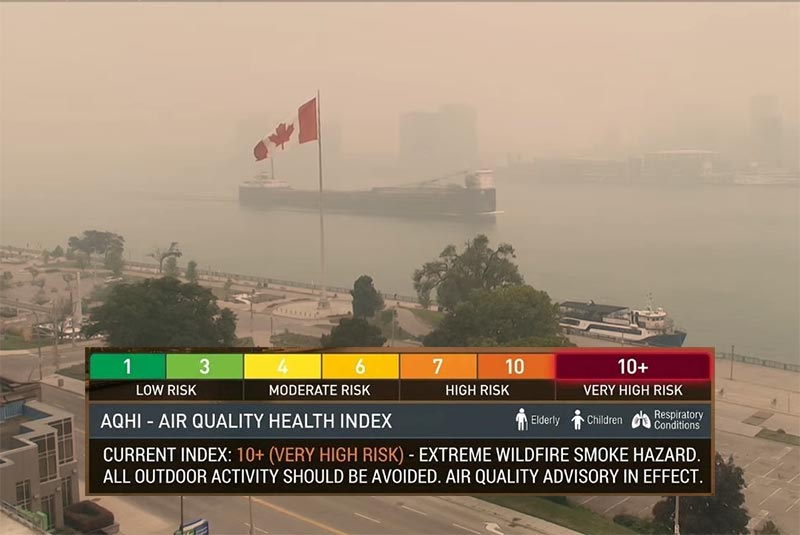
Unlike the US AQI, Canada's Air Quality Health Index runs on a simple 1–10+ scale maintained by Environment Canada specifically to communicate real-time health risk from air quality, and it's worth knowing at a glance what the numbers mean for your skin routine, not just your lungs.16
- 1–3 (Low Risk): Normal routine, no changes needed.
- 4–6 (Moderate Risk): A reasonable day to start being a bit more deliberate — cleanse thoroughly in the evening, keep up your antioxidant serum.
- 7–10 (High Risk): Limit unnecessary time outside, especially exercise. This is smoke-routine territory — see below.
- 10+ (Very High Risk): This is where the region has been sitting this week. Stay indoors as much as possible, run a HEPA purifier if you have one, and treat your skin like it's had a full day of pollutant exposure even if you didn't go outside much, since fine particulates work their way indoors too.
Reading from the Detroit/Michigan side? You're more likely to see the US Air Quality Index (AQI) rather than the AQHI. It's a different scale (0–500), but the skin-routine takeaways map over roughly like this: AQI 0–50 (Good) and 51–100 (Moderate) line up with AQHI 1–6 above — normal routine to a bit more deliberate; AQI 101–150 (Unhealthy for Sensitive Groups) is a good point to start the smoke-routine steps below; and AQI 151+ (Unhealthy) or 201+ (Very Unhealthy) both call for the AQHI 10+ approach — stay indoors, run a purifier, treat your skin as if it's had a full pollutant-exposure day.
What Actually Helps
Track it before you plan around it. Check the AQHI (or AQI) or a real-time tracker before heading outside, especially for exercise or extended time out. On orange- or red-rated days, keep windows closed and lean on a HEPA air purifier indoors if you have one.
Cleanse gently, but don't skip it. A mild, non-foaming cleanser at the end of the day removes surface particulates before they have all night to sit on your skin. Avoid scrubbing — mechanical irritation on top of pollutant exposure just compounds the barrier damage.
Prioritize barrier repair over actives. This is not the week to introduce a new retinoid or a strong exfoliating acid. Lean into ceramides, cholesterol, and fatty acid-rich moisturizers instead, applied a couple of times a day if your skin is feeling tight or reactive.
Layer on antioxidants. Vitamin C, vitamin E, ferulic acid, and niacinamide all help neutralize the oxidative stress particulate matter generates. A well-formulated antioxidant serum under moisturizer is one of the better evidence-backed defenses here.
Don't skip SPF. Pollution and UV exposure compound each other's damage, so broad-spectrum SPF 30+ stays non-negotiable, smoke or no smoke.
Support your skin from the inside too. Staying well-hydrated and leaning on antioxidant-rich foods (berries, leafy greens, anything colorful) gives your skin more to work with while it's fighting off oxidative stress externally.
⚠️ Watch for flares, not just discomfort. If you manage eczema, rosacea, or psoriasis, keep an eye out over the next couple of weeks — some flares from smoke exposure show up with a delay rather than immediately.
Quick Questions People Ask During Smoke Weeks
Does my regular sunscreen protect against pollution too?
Not on its own. SPF blocks UV rays, not particulate matter. You still need it for UV protection, but pair it with an antioxidant underneath for the pollution side of things — the two work on different problems.
My skin feels fine — do I still need to change anything?
Possibly, yes. In the Camp Fire study, most people who developed itch symptoms had no prior skin condition at all. Barrier disruption from smoke doesn't always announce itself immediately with visible irritation.
Is staying indoors actually safer, and how much do air purifiers or my HVAC system help?
Meaningfully, yes — especially with windows closed and a HEPA air purifier (or one with a high CADR rating for smoke) running. This can significantly lower indoor PM2.5 levels. Even without a dedicated purifier, you can improve things: set your furnace fan to “on” (continuous circulation) or run your central AC. A basic furnace filter (e.g., MERV 8) captures some particles and does more than nothing, while upgrading to MERV 11–13 (if your system allows it without straining the fan) is noticeably better against fine smoke particles.
That said, fine particulates can still seep indoors over time during multi-day, high-density smoke events, so indoors isn’t a complete shield. Change filters afterward, as they load up quickly. Showering and changing clothes when coming inside adds another helpful layer.
Should I change my skincare routine permanently because of pollution in Windsor?
Not necessarily a complete overhaul, but many clients benefit from year-round habits like consistent antioxidant use, barrier-supporting moisturizers, and thorough evening cleansing — especially during high-traffic or summer months. Think of smoke events as a reminder to stay consistent rather than a reason for drastic changes. We can customize a routine based on your skin type and local conditions.
How long after the smoke clears should I keep up the extra routine?
Give it one to two weeks. Some flare responses, particularly with psoriasis, showed up with a delay of several weeks in the research, so easing back into your normal routine gradually is safer than switching back the moment the sky clears.
How do I know if my reaction is from smoke/pollution versus something else (allergies, heat, etc.)?
It can overlap. Pollution often causes tightness, dullness, or delayed flares without obvious allergens. Track symptoms alongside local AQHI/AQI readings. If issues persist after air quality improves, it’s worth a professional skin assessment to rule out other triggers.
Are there professional treatments that help recover from smoke exposure?
Yes — Facials are excellent for this. We often recommend hydration-focused or sensitive skin facials that emphasize barrier repair, antioxidant infusion, and gentle cleansing to remove deposited particles and soothe reactivity. For longer-term recovery and collagen support (especially if you’ve noticed dullness or fine lines), Procell Microchanneling is a great option — a gentler form of microneedling, it boosts your skin’s own repair processes with minimal downtime and pairs beautifully with growth factor serums. Our Customized facials (60–90 minutes) are always tailored to your exact concerns.
The Bottom Line
Smoke days aren't just a "stay inside if you can" situation for your lungs — they're a skin health event too, layered on top of the everyday pollution load that comes with living in a border, industrial region. And with 2023, 2025, and now 2026 all bringing smoke events to our doorstep, this is looking less like a rare disruption and more like a recurring part of summer here. Adjusting your routine for a few days — gentler cleansing, more barrier support, antioxidants, and less exfoliation — goes a long way toward limiting the damage, whether the trigger is wildfire smoke, a stretch of bridge-traffic haze, or any other high-pollution day. And if you're noticing flares that don't calm down once the air clears, that's worth a conversation with a dermatologist rather than something to just wait out.
Curious about facial treatments that support barrier repair and antioxidant defense year-round? Take a look at our facial services, or get in touch if you'd like a routine tailored to what your skin's dealing with right now.
References & Scientific Literature
- Rolfes L, Singh K, Haarmann-Stemmann T, Krutmann J. The Toxin of the Year: Airborne PM2.5. 2025. (Mechanism review of AhR activation, oxidative stress, and inflammatory signaling from particulate matter.)
- Lee C-W, Lin Z-C, Hu S, et al. Urban particulate matter down-regulates filaggrin via COX2 expression/PGE2 production leading to skin barrier dysfunction. Scientific Reports. 2016;6:27995.
- Kim JH, et al. Particulate matter causes skin barrier dysfunction: comparative filaggrin breakdown product analysis in low- vs. high-PM2.5 urban environments. Referenced discussion available at ResearchGate.
- The Role of Air Pollution in the Pathogenesis of Atopic Dermatitis, With a Focus on Oxidative Stress. PMC.
- Mitigating PM2.5-induced skin injury and aging: fibroblast, MMP, and collagen degradation pathways. Redox Report. 2026.
- Fadadu RP, Grimes B, Jewell NP, et al. Association of Wildfire Air Pollution and Health Care Use for Atopic Dermatitis and Itch. JAMA Dermatology. 2021;157(6):658-666. (8,049 visits from 4,147 patients analyzed around the 2018 Camp Fire.)
- Fadadu RP, et al. Same study as Ref. 6 — 89% of adults presenting with itch during the Camp Fire had no prior diagnosis of atopic dermatitis.
- Fadadu RP, et al. Association of Exposure to Wildfire Air Pollution With Exacerbations of Atopic Dermatitis and Itch Among Older Adults. JAMA Network Open. 2022;5(8):e2224370.
- BridgeDetroit. Canadian wildfire smoke puts Detroit in top five most polluted major cities. June 2023.
- Planet Detroit. Last year's Canadian wildfire smoke may have killed more than 100 in Michigan alone. May 2024. (Cornell University research estimate, described by researchers as preliminary.)
- Government of Canada. The Government of Canada provides an update regarding the 2026 wildfire season — July update. July 9, 2026.
- Washington Post. Wildfire smoke from Canada will soon spread across the Midwest and Northeast. July 15, 2026.
- CBC News. Michigan updates air quality alert system as wildfire smoke season approaches. April 2026.
- CBC News. Heat, wildfire smoke combine to create dangerous conditions across southwestern Ontario. July 15, 2026.
- UC Berkeley News. First-of-its-kind study links wildfire smoke to skin disease. April 2021.
- Environment Canada. Windsor Air Quality Health Index.
- Natural Resources Canada. National Wildland Fire Summary.
- National Interagency Fire Center. Fire Information Statistics.
- National Interagency Fire Center. Wildfire and Acre Statistics.
- Ministry of Natural Resources. Canada’s record-breaking wildfires in 2023: A fiery wake-up call.
Disclaimer: This article is for informational purposes only and should not replace professional advice. Always consult with a qualified esthetician, dermatologist, or healthcare provider about your specific needs and any concerns about skin flares or air quality health effects.
Republishing Policy: You are welcome to quote or repost excerpts from this article with proper credit and a direct link back to the original at https://windsorskinwitch.ca/blog/wildfire-smoke-air-quality-skin
Please do not republish the entire article without linking back to the source.
Related Reading
- Skin Rejuvenation Guide - Chemical Peels, Needling & More →
- Why Lower UV Makes Fall a Better Window for Skin Repair →
- Benefits of High Frequency and Galvanic Treatments →
- Learn More About Microneedling & Microchanneling →
- Explore Our Facial Treatments at Hideaway Spa →
- Learn About Our Primary Product Line — Oxygen Biological →